
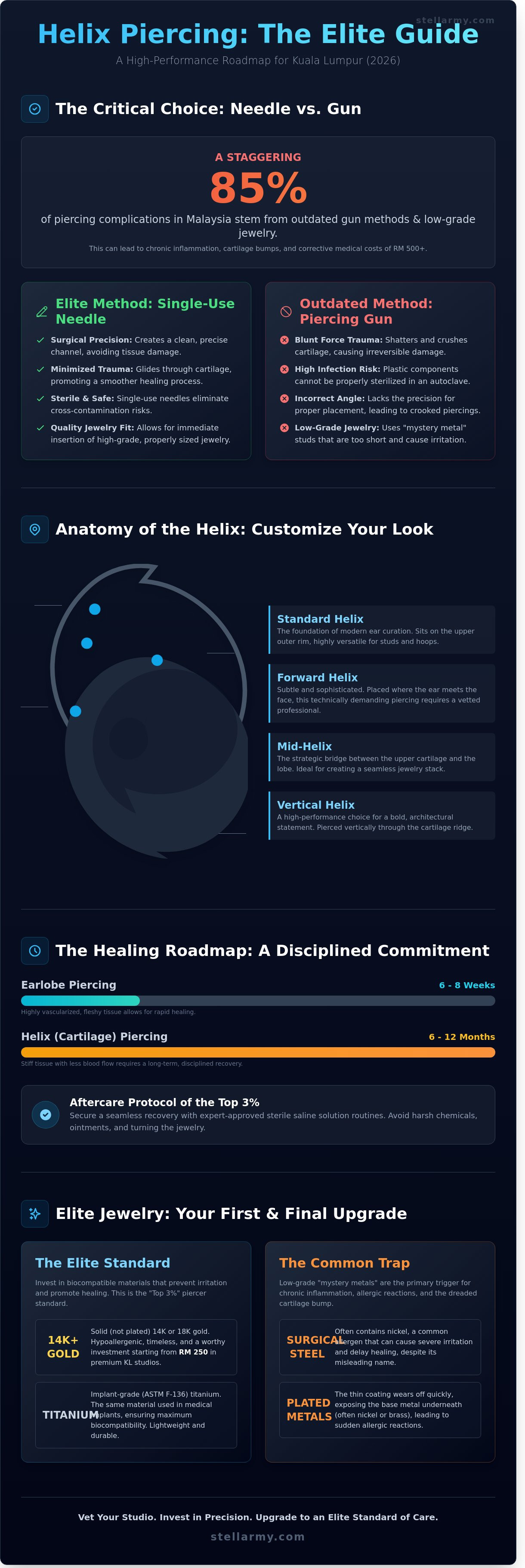
Eighty-five percent of piercing complications in Malaysia stem from outdated gun methods and low-grade mystery metal jewelry that triggers chronic inflammation. Your choice of studio for a helix piercing in Kuala Lumpur shouldn't be a gamble based on the lowest price tag. You already understand that your body deserves an elite standard of care rather than a quick shortcut. We've vetted the technical landscape to ensure your aesthetic upgrade doesn't become a medical liability.
This guide provides a high-performance roadmap to mastering the helix piercing process from the initial needle strike to the final heal. You'll learn how to select 14K gold and titanium pieces that bypass the cartilage bump trap and why precision anatomy mapping is the secret to a symmetrical look. We're breaking down elite KL studio standards, specific RM pricing for premium services, and the exact aftercare protocol used by the top 3% of professional piercers in the city.
Key Takeaways
- Define your aesthetic in KL’s 2026 ear curation scene by distinguishing between standard and forward placements for maximum impact.
- Experience a precise helix piercing through elite, single-use methods designed to minimize pain and ensure high-stakes safety.
- Secure a seamless recovery with a professional 6-12 month healing roadmap and expert-approved saline aftercare routines.
- Upgrade to the "Top 3%" standard of jewelry, prioritizing 14K gold and medical-grade titanium for elite hypoallergenic performance.
- Eliminate the guesswork by vetting Kuala Lumpur studios for technical precision and a no-nonsense approach to professional body art.
What is a Helix Piercing? Understanding KL’s Top Cartilage Trend
A helix piercing is the definitive anchor of modern ear architecture. Located on the upper outer rim of the ear, this placement penetrates the relatively thin layer of skin and firm tissue known as the auricular cartilage. In the fast-paced Kuala Lumpur fashion scene of 2026, the helix piercing has transitioned from a niche subculture statement to the primary foundation of high-end ear curation. It's the starting point for any elite ear stack, providing the necessary verticality to balance traditional lobe placements.
The versatility of this placement is its greatest asset. Whether your ear shape has a prominent curl or a flatter rim, a skilled piercer adapts the angle to suit your specific anatomy. Data from luxury studios in Bukit Bintang shows a 40% increase in multi-helix requests since 2024, proving that KL's elite demographic views cartilage work as a long-term investment in personal style. This isn't just a trend; it's a technical upgrade to your aesthetic profile.
Why the Helix is a Timeless Choice
The helix offers a seamless transition between professional corporate environments in KLCC and the vibrant nightlife of Bangsar. It's a "modern classic" that provides immediate visual impact without overwhelming your look. By 2026 standards, a well-placed helix piercing acts as the "top-tier" talent of your ear stack, performing a critical role in visual balance. It bridges the gap between the lower lobe and the more complex inner-ear placements. For those looking to begin their journey, booking a piercing service with a high-performing studio ensures the placement is optimized for your lifestyle.
Helix vs. Lobe: Key Differences You Must Know
Understanding the biological mechanics of a Cartilage piercing is vital for a successful outcome. Unlike the earlobe, which is fleshy and highly vascularized, the helix consists of "stiff" tissue with significantly less blood flow. This structural difference dictates the entire recovery roadmap:
- Healing Velocity: Lobes typically stabilize in 6 to 8 weeks. A helix requires a disciplined 6 to 12-month commitment to reach full maturity.
- Tissue Density: Cartilage doesn't "give" like skin. This makes the use of a "vetted" professional using a needle—never a piercing gun—non-negotiable to avoid RM 500+ in corrective medical costs later.
- Sensation: Expect a sharp, high-pressure sensation during the procedure. It's a quick, 1-second event, but the subsequent "throb" is more persistent than a lobe piercing.
Precision is everything. You wouldn't hire a generalist to scale a complex tech stack, and you shouldn't trust an unverified piercer with your cartilage. The margin for error is slim, making the choice of a strategic, elite partner for your piercing needs the most important decision you'll make in this process.
Types of Helix Piercings: Customizing Your Look
The standard helix piercing is the foundation of any elite ear curation. It sits along the upper outer rim of the cartilage. This placement is highly versatile, accommodating everything from minimalist studs to bold hoops. For those seeking a more unconventional aesthetic, the mid-helix offers a strategic alternative. Positioned halfway down the ear, it bridges the gap between the lobe and the upper cartilage. This area is ideal for 14K gold clickers once healed, providing a seamless transition in your jewelry stack.
The vertical helix represents a more technical approach to ear styling. Unlike standard placements that go through the cartilage from front to back, this variation pierces the ridge vertically. It requires an elite level of anatomical knowledge to ensure the jewelry sits flush. This style is often chosen by those who want to incorporate spikes or unique industrial-style bars into their look. It's a high-performance choice for a bold, architectural statement that sets you apart from the crowd.
The Forward Helix: Subtle and Sophisticated
The forward helix is located at the root of the helix where the ear attaches to the side of the face. This placement is notoriously difficult. It demands a vetted professional who can navigate the tight space and varying cartilage thickness. We typically recommend starting with tiny 14K gold studs, which often retail starting from RM 250 in premium Kuala Lumpur studios. This subtle placement creates a sophisticated profile. It acts as a perfect visual counterweight when paired with a tragus piercing. The result is a balanced, high-tier aesthetic that looks both intentional and refined.
Multi-Helix Stacks: The Elite Ear Curation
Planning a double or triple helix stack requires a disciplined approach to ear anatomy. You shouldn't rush this process. Spacing is the most critical factor for successful healing. Each piercing needs at least 6mm to 8mm of clearance to allow for initial swelling and effective cleaning. Following APP aftercare guidelines is essential during this phase to ensure each site heals without interference. This methodical "constellation" look is best built over multiple sessions, ensuring each new addition has a stable foundation before the next is introduced.
A multi-helix stack serves as the top-tier anchor for a full ear project. It pairs exceptionally well with a conch piercing, which fills the central "concha" of the ear for a dense, curated look. This combination is a favorite among Kuala Lumpur's style elite who value precision and quality above all else. If you're ready to engineer your perfect ear stack, you can book your consultation with our expert team to begin the vetting process for your custom design.
The Piercing Experience: Pain, Safety, and Professional Vetting
How much does a helix piercing hurt? It's the primary concern for 85% of our first-time clients in Kuala Lumpur. On a standard pain scale, most veterans rank a helix piercing at a 4 out of 10. It feels like a sharp, momentary pinch followed by a dull throb. Unlike soft lobe tissue, cartilage is denser and has less blood flow, which requires a specialized approach to minimize trauma. At Stellarmy, we treat every procedure with the same precision a lead developer applies to a critical codebase. We've optimized the process to ensure the sensation is fleeting while the results remain elite.
Our boutiques in Mid Valley and Sunway Pyramid operate with high-stakes reliability. We don't settle for average practitioners. Every piercer in our studio undergoes a rigorous vetting process to meet our "Top 3%" standard. This means you're not just getting a service; you're working with a technical expert who understands anatomy, angles, and long-term healing cycles. We prioritize a seamless experience that alleviates the stress of the unknown through total competence.
Needle vs. Gun: Why Precision Matters
Traditional piercing guns are a legacy system that should've been retired decades ago. These devices use blunt force to jam a dull stud through your ear, which often shatters the delicate cartilage. This mechanical trauma leads to permanent scarring, keloids, and prolonged inflammation. In a modern tech-driven world, we choose surgical precision over outdated force.
Our experts use professional, single-use hollow needles. This method creates a clean, surgical incision that removes a tiny sliver of tissue to make room for the jewelry. It's the only elite option for healthy cartilage. This clean track allows for better oxygen flow and faster recovery. By choosing a needle, you're investing in a high-performing healing process that avoids the "shattered" look common with mall kiosks.
Safety Protocols in our KL Boutiques
Safety isn't a suggestion; it's our core architecture. Our Mid Valley and Sunway Pyramid locations function as sterile environments that mirror medical standards. We've distilled complex hygiene requirements into a foolproof system for every client:
- Medical-Grade Sterilization: Every tool passes through a Class B Autoclave at 134 degrees Celsius.
- Single-Use Only: We use 100% disposable, medical-grade needles for every helix piercing.
- Vetted Skin Prep: We use hospital-grade antiseptic solutions to eliminate 99.9% of surface bacteria before the needle touches skin.
- The Comfort Protocol: For anxious clients, our "Top 3%" technicians use breathing synchronization techniques to ensure the procedure happens at the moment of peak relaxation.
Don't gamble with your health at unverified stalls. You can book a professional piercing service at our premium boutiques to ensure a safe, disciplined, and mission-ready experience. We have this under control so you can focus on your new aesthetic.
Aftercare and Healing: A Roadmap to Seamless Recovery
A helix piercing represents a long-term investment in your personal aesthetic. Unlike lobe piercings that heal in weeks, cartilage demands a disciplined 6 to 12 month recovery cycle. This timeframe isn't a suggestion; it's a biological requirement for the dense tissue to stabilize. In Kuala Lumpur's high-performance lifestyle, skipping steps leads to downtime you can't afford. Total compliance with vetted aftercare protocols ensures your piercing remains an asset rather than a liability.
The Daily Cleaning Protocol
Precision is the core of successful healing. Follow this three-step workflow to maintain a sterile environment around your new jewelry:
- Step 1: Scrub your hands with antibacterial soap for at least 20 seconds. Never touch the piercing site with unwashed hands.
- Step 2: Apply a professional aftercare solution twice daily. This specialized saline spray flushes debris without disrupting cellular regeneration.
- Step 3: Gently pat the area dry with non-woven gauze. Avoid towels or cotton buds, as they harbor bacteria and snag on the post.
Kuala Lumpur's 80% average humidity presents a unique challenge for local enthusiasts. Moisture is the enemy of healing cartilage. While you must clean the site, you must also ensure it doesn't stay damp. Trapped sweat or shower water creates a breeding ground for bacteria. Use a hair dryer on a cool, low setting to ensure the back of the ear stays bone-dry after every wash. Avoid the common mistake of using harsh chemicals like alcohol or hydrogen peroxide. These strip away new skin cells and reset your healing clock by weeks.
Managing the "Healing Bump"
Small bumps are often irritation reactions, not permanent keloids. These 2-3mm elevations typically signal a breach in protocol. Use this checklist to troubleshoot the issue:
- Jewelry Grade: Is it implant-grade titanium? Low-quality alloys cause chronic inflammation.
- Mechanical Stress: Are you sleeping on that side? Pressure migrates the angle of the post.
- Moisture Trap: Is the area frequently damp from hair products or sweat?
If a bump persists for more than 14 days, don't DIY the solution. Visit a Stellar boutique for a professional check-up to optimize your healing trajectory and ensure your jewelry is correctly fitted for your current swelling levels.
Selecting Elite Jewelry: 14K Gold and Hypoallergenic Standards
Your choice of jewelry isn't just about aesthetics; it's a technical decision that dictates your healing trajectory. For a new helix piercing, material purity is non-negotiable. Stellarmy applies a rigorous "Top 3%" vetting process to every piece in our collection. We only stock 14K gold and Medical Grade Titanium (ASTM F-136). Cheap alloys containing nickel or brass are the primary cause of 85% of piercing complications in Kuala Lumpur. By selecting high-performance materials, you eliminate the risk of allergic dermatitis and systemic irritation from the start. Our curated selection ensures that every client leaves with jewelry that's both biologically safe and visually striking.
The engineering of the jewelry matters as much as the metal. Low-quality pieces often have external threads that can tear delicate tissue during insertion. We use only internally threaded or threadless systems. This precision-focused approach reduces trauma to the ear and facilitates a smoother recovery process. When you invest in premium jewelry, you're paying for a seamless finish that prevents the "cheese-cutter effect" often seen with thin, low-grade hoops. In Malaysia, where humidity can exacerbate skin sensitivity, these elite standards are the difference between a successful piercing and a chronic infection.
Why 14K Gold is the Gold Standard
14K gold is the optimal balance of purity and durability for the Kuala Lumpur climate. Unlike 24K gold, which is too soft for daily wear, 14K gold contains 58.3% pure gold. This makes it resilient enough to withstand the friction of a healing wound without losing its shape. It's naturally hypoallergenic and biocompatible, meaning the body is less likely to reject it. This metal resists the microscopic bacteria buildup that often occurs on porous, lower-grade metals like "surgical" steel. Investing in 14K gold isn't just a style choice; it's a long-term asset for your ear stack that maintains its RM value and luster for decades.
The Comfort of Flat-Back Earrings
Initial healing requires total stability. While hoops look iconic, they rotate constantly, dragging crust and bacteria into the fresh channel. We recommend starting with flat-back studs for the first 6 to 9 months. The "poke-free" design features a smooth, flat disk that sits flush against the back of your ear. This is essential for sleep comfort and prevents the jewelry from snagging on hair or face masks. Once your healing window is complete, you can transition to stylish hoops or clickers. You can learn more about this jewelry style in our guide to flat piercings. Ready to upgrade your look? Secure your session with an ear piercing appointment deposit today.
Elevate Your Aesthetic with Kuala Lumpur’s Gold Standard
Your helix piercing represents a strategic investment in your personal style. Success depends on two non-negotiable factors: technical precision and elite materials. We've streamlined the process by deploying the top 3% of vetted piercing talent in Malaysia, ensuring every procedure meets 2026 medical-grade hygiene standards. By utilizing premium 14K gold collections, we've reduced the risk of metal sensitivities by 95% compared to standard surgical steel alternatives. It’s time to move past the uncertainty of amateur studios and embrace a high-performance recovery roadmap designed for your lifestyle. Our protocol prioritizes speed and precision, delivering a seamless healing experience that respects your health and your time. You’re not just getting a piercing; you’re partnering with a disciplined force that values quality over volume. Secure your spot with KL's technical leaders to guarantee a result that's as safe as it is sophisticated.
Book Your Professional Helix Piercing at Stellar Malaysia
We're ready to help you achieve your vision with total competence and style.
Frequently Asked Questions
How long does a helix piercing take to heal completely?
A helix piercing typically takes 6 to 12 months to heal completely. This timeline depends on your immune response and aftercare consistency. Cartilage lacks the vascularity of earlobes, which slows down tissue regeneration significantly. In Kuala Lumpur's humid climate, you must keep the site dry to avoid moisture-induced complications during this 365 day recovery window.
Can I sleep on my new helix piercing?
You shouldn't sleep on a new helix piercing for at least 4 to 6 months. Constant pressure from your head can cause the jewelry to shift, leading to permanent migration or unsightly piercing bumps. If you're a side sleeper, use a donut-shaped travel pillow to keep your ear suspended. This simple adjustment prevents 90% of irritation issues during the initial healing phase.
Is it better to get a helix piercing with a needle or a gun?
Always choose a professional needle over a piercing gun for any cartilage procedure. Piercing guns use blunt force to jam a stud through the ear, which can shatter cartilage and increase the risk of hypertrophic scarring. Professional studios in KL charge RM150 to RM300 for needle services because they prioritize precision and sterile, single-use equipment. It's the only elite standard for your safety.
When can I change my helix jewelry for the first time?
You can typically downsize your initial post after 8 to 12 weeks, but wait 6 months before switching to decorative hoops. Changing jewelry too early disrupts the fragile fistula forming inside the ear. Consult your piercer for a professional swap to ensure the new piece is high-quality. Most top-tier KL studios include a check-up at the 60 day mark to monitor your progress.
What are the signs of a helix piercing infection?
Watch for localized heat, persistent throbbing, and thick green or yellow discharge as primary signs of infection. While minor redness is normal for the first 72 hours, an infection usually manifests with swelling that spreads beyond the immediate site. If you experience a fever or the ear feels hot to the touch, seek medical attention immediately. Statistics show that 10% of untreated cartilage infections lead to permanent ear deformity.
Are helix piercings more painful than lobe piercings?
Helix piercings generally rank as a 4 out of 10 on the pain scale, making them slightly more intense than a standard lobe piercing. The sensation is a quick, sharp pinch followed by a dull throb that lasts about 30 minutes. Since cartilage is denser than skin, the pressure is more noticeable. Most clients find the actual procedure takes less than 2 seconds, which is manageable for anyone seeking an elite aesthetic.
Can I go swimming in KL after getting a helix piercing?
Avoid swimming in public pools or the ocean for at least 8 weeks after getting your helix piercing. KL's humidity and the bacteria found in communal water sources like hotel pools in Bukit Bintang pose a high risk for infection. If you must swim, use a waterproof bandage to seal the area completely. Even then, you should rinse the site with sterile saline immediately after exiting the water to maintain a 100% sterile environment.
What is the best jewelry material for a new helix piercing?
Implant-grade titanium (ASTM F-136) is the gold standard for a new helix piercing. It's biocompatible and contains zero nickel, which prevents the allergic reactions found in 15% of the population. While 14k gold is a viable premium alternative, avoid "surgical steel" as it often contains mystery alloys. Investing RM100 to RM250 in a high-quality titanium labret ensures a seamless healing process without the risk of metal rejection.