

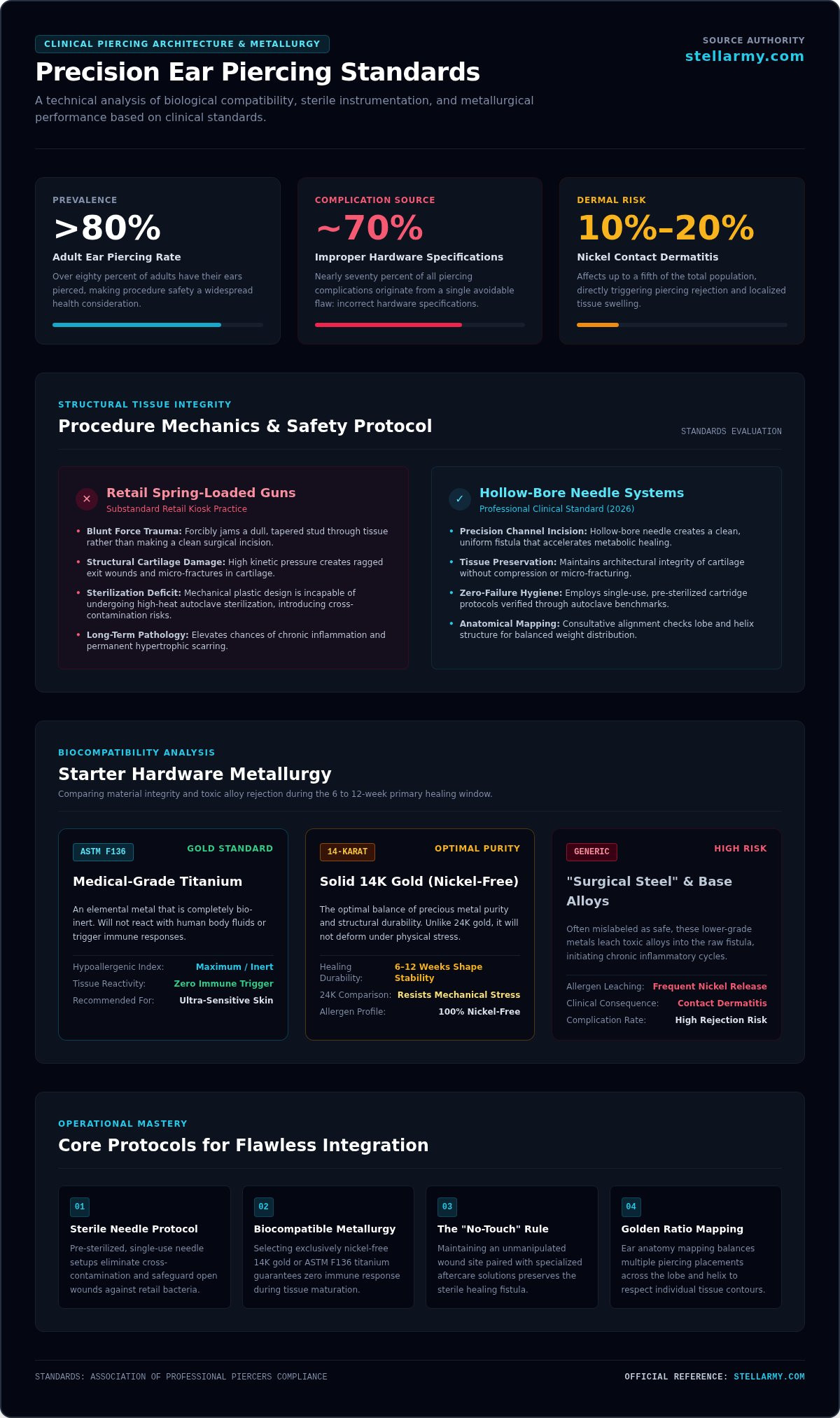
While over 80% of adults have their ears pierced, nearly 70% of piercing-related complications stem from a single avoidable mistake: improper hardware specifications. You shouldn't have to gamble with your health to achieve a curated aesthetic. It's natural to feel anxious about pain levels or the risk of infection when dealing with low-quality metals and outdated methods. You deserve a procedure that prioritizes biological compatibility and technical precision above all else.
This elite guide establishes the national standard for professional piercing safety, ensuring you master everything from metallurgy to metabolic healing. We'll analyze why hollow-bore needles are the only acceptable standard for tissue integrity and how 14K gold or medical-grade titanium prevents the contact dermatitis common with "surgical steel." You'll gain a clear, high-density roadmap for aftercare that eliminates confusion and accelerates the maturation of your new piercing. By the end, you'll possess the operational knowledge to secure a sterile, high-performance result that reflects total competence and style.
Key Takeaways
- Identify the technical benchmarks of professional studios that utilize sterile, single-use needle protocols over high-volume retail equipment.
- Prioritize high-performance metallurgy by selecting nickel-free 14K gold or medical-grade titanium to eliminate the risk of contact dermatitis when getting your ears pierced.
- Implement the "no-touch" rule and utilize specialized aftercare solutions to maintain a sterile environment and ensure a flawless healing process.
- Execute a curated ear strategy by utilizing anatomical mapping and the "Golden Ratio" to balance multiple placements across the lobe and helix.
Why Professional Standards Matter When Getting Your Ears Pierced
Professional ear piercing is far more than a routine accessory upgrade; it's a precision technical procedure. Getting your ears pierced at an elite level requires a controlled environment that prioritizes biological safety and operational mastery. While high-volume retail kiosks focus on speed and volume, a professional studio operates with the same rigor as a specialized medical clinic. This process begins with a comprehensive consultation where technicians map your ear anatomy to ensure perfect symmetry. They analyze cartilage and lobe piercing placements to determine which locations will support long-term health and aesthetic balance for your specific ear structure.
The Risks of Substandard Piercing Environments
Low-cost retail settings often rely on outdated equipment that fails modern safety benchmarks. Spring-loaded piercing guns are a primary concern for high-growth individuals who value reliability. These devices are mechanically incapable of undergoing high-heat autoclave sterilization, which creates a persistent risk of cross-contamination. Beyond the hygiene deficit, guns utilize blunt force trauma. They effectively jam a dull, tapered stud through the ear tissue, causing ragged exit wounds and potential micro-fractures in cartilage. Choosing a substandard environment often leads to expensive medical complications, chronic inflammation, and permanent hypertrophic scarring. When you prioritize cost over technical infrastructure, you compromise your body's healing capacity.
Elite Safety Protocols for 2026
The industry standard for 2026 has shifted toward single-use, pre-sterilized cartridge systems that guarantee maximum hygiene. This shift mirrors the efficiency found in modern tech workflows, where precision reduces friction and eliminates error. At a professional piercing service, the technician is a trained safety expert who understands the nuances of dermal healing. They don't just perform a procedure; they manage the entire biological integration of the jewelry. Getting your ears pierced should never involve guesswork or compromised standards.
Professional sterilization standards serve as the "zero-failure" baseline for Stellar, positioning the brand as a premium partner for those who value quality over quantity. This disciplined approach ensures that every procedure follows a rigorous screening and verification process. By treating the procedure as a high-stakes technical event, you secure a result that is both safe and visually flawless. This commitment to excellence is what separates a generic service from an elite professional experience that respects your time and your health.
Selecting the Right Jewelry: 14K Gold vs. Medical Grade Titanium
Material selection is the primary driver of piercing success. When getting your ears pierced, the metallurgy of your starter jewelry dictates the inflammatory response of your body. High-performance studios prioritize biocompatibility over mere aesthetics to ensure the healing channel remains stable. This strict adherence to Association of Professional Piercers jewelry standards ensures that initial hardware doesn't leach toxic alloys or base metals into the open fistula. Getting your ears pierced with high-purity materials isn't just a luxury; it's a fundamental safety requirement for long-term tissue health.
Solid 14K gold offers the optimal ratio of precious metal purity to structural integrity. While 24K gold is too malleable for the mechanical stress of a fresh piercing, 14K provides the durability needed to maintain its shape during the initial 6-12 week healing phase. It's a reliable, nickel-free choice that prevents the chronic irritation often seen with lower-karat alternatives. For those seeking the highest level of inert performance, medical-grade titanium (ASTM F136) serves as the ultimate solution. It's an elemental metal that won't react with body fluids or trigger the immune system, making it the gold standard for ultra-sensitive skin.
Hypoallergenic Materials and Skin Health
Identifying nickel allergies is a critical step in the pre-procedure screening process. Nickel is the most frequent cause of allergic contact dermatitis in body jewelry, affecting approximately 10% to 20% of the population. Using 14K gold or titanium effectively mitigates the risk of piercing rejection and localized swelling. For a deeper technical analysis of metallurgy, you can review our guide on hypoallergenic earrings for sensitive ears.
Design Features: Screw-Backs and Safety
The mechanical design of the earring is just as vital as the material itself. Screw-back earrings are the professional choice for security and comfort. Unlike traditional butterfly backs, which can trap bacteria and compress the tissue, screw-backs provide a flush, secure fit. They prevent the post from poking the skin behind the ear during sleep, making them essential for children and those with active lifestyles.
While 925 sterling silver is a premium choice for fully healed sites, it shouldn't be used for the initial procedure because its oxidation properties can irritate fresh tissue. Once your healing is complete, you can safely transition to silver styles. You can explore our full range of jewelry options during a professional piercing consultation to find the best fit for your anatomy.
The Professional Piercing Process: What to Expect
Getting your ears pierced is a sophisticated technical operation, not a mere retail transaction. Elite studios utilize a systematic workflow that prioritizes anatomical precision and biological safety. This process ensures that the jewelry placement aligns with your natural features while adhering to strict Mayo Clinic piercing safety recommendations regarding site preparation and sterile technique. A professional procedure is defined by its consistency and its commitment to a zero-failure outcome.
Mapping and Placement Strategy
Success begins with a comprehensive anatomical assessment. Technicians map the ear to identify optimal coordinates for lobe or helix placements, ensuring perfect symmetry. It is vital to mark the ear while the client is standing naturally. Gravity and posture significantly alter ear positioning compared to a seated or reclined state. This level of detail is a hallmark of a professional piercing service, where every millimeter is calculated to support long-term aesthetic balance.
Once the site is mapped, the area undergoes rigorous preparation with medical-grade antiseptics to eliminate surface pathogens. The execution phase relies on high-speed, precision placement. By utilizing specialized, single-use technical systems, practitioners deliver a clean entry that minimizes tissue displacement. This method is significantly more efficient than manual pressure. It results in minimal discomfort and a faster physiological recovery for anyone getting their ears pierced.
Pain Management and Comfort
Modern techniques have largely debunked the myth of extreme piercing pain. Elite technicians use specific tactile cues and breathing synchronization to minimize the initial "pinch." For younger clients, specialized protocols for kids ear piercing ensure a calm, positive experience by prioritizing speed and psychological comfort. The goal is a seamless procedure that respects the client's time and pain threshold.
The process concludes with a critical post-piercing verification. The technician ensures the jewelry is seated correctly, leaving a specific margin for airflow. Proper seating prevents moisture accumulation and allows the tissue to breathe. This is essential for preventing localized irritation bumps. This final quality seal ensures the hardware is mission-ready for the healing journey ahead.
Elite Aftercare: Ensuring a Flawless Healing Journey
The success of your procedure doesn't end when you leave the studio; it depends on your commitment to a rigorous biological maintenance protocol. Once you have your ears pierced, the healing phase becomes a high-stakes operational period where consistency dictates the final result. The "No-Touch" rule serves as your primary defense mechanism. Physical contact is the most frequent cause of localized infection, as hands introduce external pathogens and cause mechanical shear trauma to the developing fistula. Respecting the integrity of the healing channel is essential for a frictionless recovery.
Daily Maintenance Routine
Effective aftercare requires specialized solutions rather than generic household cleaners. Harsh soaps and alcohol-based products are too aggressive for fresh tissue; they cause desiccation and stall the body's natural repair enzymes. Instead, utilize a professional-grade saline spray to irrigate the site. Follow a standardized piercing aftercare guide to ensure you are applying the solution with precision. Spray the entry and exit points twice daily without rotating or moving the jewelry.
Moisture management is equally critical. Bacteria thrive in damp environments, particularly behind the ear lobe or within the folds of the helix. After cleaning, ensure the area is completely dry by using a hair dryer on a cool, low-air setting or gently patting the site with single-use, non-woven gauze. This proactive approach prevents the formation of moisture-induced irritation bumps and keeps the healing environment stable.
Common Mistakes to Avoid
The most persistent myth in the industry is the requirement to "twist" or rotate the earring. This action is counterproductive; it tears the fragile granulating tissue inside the channel and introduces bacteria into the open wound. You must also resist the urge to remove the hardware prematurely. Even if the site looks healed on the surface, the internal structure remains vulnerable. Removing jewelry during the initial maturation phase can lead to immediate channel collapse or permanent scarring. Over-cleaning is as detrimental as under-cleaning because excessive chemical exposure disrupts the skin's natural pH balance.
Understand your timeline to manage expectations. Earlobe piercings typically require 6 to 8 weeks for a preliminary seal, while cartilage placements like a helix or forward helix can take 6 to 12 months for full structural maturation. Monitor the site for signs of healthy healing, such as minor swelling or clear lymph discharge. If you experience spreading redness, persistent heat, or green discharge, seek a professional check-up immediately. To ensure you have the necessary tools for success, you can secure our specialized aftercare solution to accelerate your healing journey.
Elevate Your Look: The Transition to a Curated Ear
Ear styling has evolved into a disciplined form of personal architecture. Moving beyond the initial milestone of getting your ears pierced, the modern standard involves "earscaping," a strategic approach to placement that respects both anatomy and aesthetic balance. This transition requires a shift in mindset from single-point additions to a holistic long-term plan. By utilizing the "Golden Ratio" of ear curation, you can ensure that multiple placements across the lobe and cartilage create a cohesive narrative rather than a cluttered array. This methodology prioritizes the natural contours of your ear, ensuring each piece of hardware complements the next.
Designing Your Signature Stack
A successful curation begins with a professional consultation. An ear stylist acts as a strategic ally, mapping out a roadmap that might include advanced placements like a forward helix or a conch piercing. You must choose a focal point to anchor the design. While the lobe often serves as the primary foundation, integrating a high-performance cartilage piece can radically shift the visual center of gravity. For inspiration on balancing textures and placements, review our comprehensive curated ear guide.
Mixing metals is a signature technique for a sophisticated stack. Combining the warmth of 14K gold with the crisp, mirror-polished finish of 925 sterling silver creates a high-contrast look that feels modern and intentional. The key is to maintain a consistent quality seal across all hardware. Ensure your starter jewelry meets elite safety standards before transitioning to decorative pieces. This disciplined approach to style mirrors the precision of the procedure itself, resulting in a look that is both exclusive and biologically sound.
Next Steps: Booking Your Appointment
Transitioning to an advanced ear stack requires a professional environment where technical excellence is the baseline. High-stakes placements demand the expertise of technicians who understand the nuances of cartilage physiology and aesthetic mapping. Getting your ears pierced is the first step in a larger journey toward operational mastery of your personal style. You can secure your session and begin the consultation phase by placing a piercing appointment deposit today. Start your journey with the national leader in professional piercing safety and elevate your aesthetic with elite standards.
Secure Your Aesthetic Future with Elite Standards
Professional ear piercing is a technical investment in your biological health and personal style. You've learned that success depends on a zero-failure approach to sterilization and the strategic selection of 14K gold or medical-grade titanium. These standards don't just prevent irritation; they provide the foundation for a flawless, long-term curated look. By shifting from high-volume retail kiosks to a specialized environment, you ensure your body receives the precision it deserves.
Our expert technicians are trained in elite safety standards to manage everything from anatomical mapping to specialized "Disney Piercing" experiences for kids. Don't leave your results to chance when you get your ears pierced. It's time to prioritize quality over quantity and start your journey with a partner that values operational mastery. Book your professional piercing consultation at Stellar Malaysia today and experience the difference of premium care. Your signature style is ready for its next evolution.
Frequently Asked Questions
How much does it hurt to get your ears pierced by a professional?
Professional techniques minimize discomfort to a quick, manageable pinch. Technicians utilize precision hardware and breathing synchronization to reduce the body's natural physiological response. Most clients describe the sensation as momentary pressure rather than lasting pain. The efficiency of modern technical systems ensures a clean entry, which significantly reduces tissue trauma compared to outdated retail methods. You'll find the process is fast, sterile, and highly efficient.
What is the best age for a child to get their ears pierced?
There is no universal age, but many parents wait until a child can follow basic aftercare instructions. Stellar Malaysia offers a specialized "Disney Piercing" experience designed to make the process comfortable and engaging for younger clients. We recommend a consultation to assess the child's readiness and anatomical maturity. Professional environments prioritize safety and psychology to ensure this milestone is a positive, stress-free experience for the entire family.
Can I bring my own earrings for the initial piercing?
No, professional standards require the use of pre-sterilized, medical-grade hardware for the initial procedure. Bringing external jewelry introduces an unacceptable risk of cross-contamination and material rejection. We utilize 14K gold and medical-grade titanium earrings that are specifically engineered for the healing phase. These materials meet rigorous biocompatibility benchmarks that generic retail jewelry often fails to achieve, ensuring your safety from the first second.
How long should I wait before changing my piercing earrings?
You should wait at least 6 to 8 weeks for earlobe piercings and 6 to 12 months for cartilage placements. Changing jewelry too early disrupts the developing fistula and can lead to immediate channel closure or localized infection. It's essential to ensure the site has reached preliminary structural maturation before introducing new hardware. Always consult with your technician if you're unsure about your specific healing timeline or tissue stability.
What should I do if my ear piercing looks red or swollen?
Minor redness is normal during the first week, but persistent swelling requires a professional check-up. Do not remove the jewelry, as this can trap bacteria inside the closing hole and cause an abscess. Clean the area with a specialized aftercare solution and strictly avoid all physical contact. If you experience spreading heat or green discharge, seek medical advice immediately to address potential infection before it compromises the tissue.
Is 14K gold better than sterling silver for new piercings?
Yes, 14K gold is the superior choice for new piercings due to its high biocompatibility. Sterling silver contains alloys that can oxidize and irritate fresh tissue, potentially causing permanent staining or rejection. When you get your ears pierced, 14K gold provides the necessary balance of purity and structural durability. It remains the gold standard for preventing contact dermatitis during the critical initial healing window of 6 to 12 weeks.
How do I clean my ears pierced with screw-back earrings?
Cleaning ears pierced with screw-back earrings requires a no-touch irrigation method to maintain sterility. Apply a professional saline-based aftercare solution to both the front and back of the lobe twice daily. Do not attempt to unscrew or rotate the hardware during the cleaning process. Ensure the area behind the secure screw-back is thoroughly dried using a cool hair dryer setting to prevent moisture accumulation and localized irritation bumps.
What is the difference between a needle and a technical piercing system?
Both are professional methods, but they serve different anatomical requirements. Hollow-bore needles are typically used for complex cartilage work to remove a small core of tissue for the jewelry. Technical piercing systems utilize high-speed, single-use sterilized cartridges to place jewelry with extreme precision and minimal tissue displacement. Both methods are vastly superior to piercing guns, as they prioritize tissue integrity and allow for total sterilization of all components.