

The earring back that feels most secure isn’t automatically the most comfortable. Screw backs twist onto a threaded post, push backs slide onto a post, and flatbacks use a flat disc behind the ear. When choosing screw back earrings in Malaysia, consider how the closure feels, how it holds the earring in place, and which metal touches your skin.
It’s easy to focus on an earring’s front, but the back affects how it sits and feels throughout the day. A closure that’s awkward to fasten or presses uncomfortably can make even a beautiful pair less practical.
This guide explains how common earring backs differ, what to consider when comparing materials and finishes, and how fit can affect comfort for sensitive ears. You’ll also learn which details influence cost without relying on one-size-fits-all price claims. Use the comparisons to narrow down the style and material that suit your ears, your routine, and the way you want your earrings to feel.
Key Takeaways
- Compare metals and finishes by how they feel against your skin, not appearance alone.
- Understand which factors affect earring costs and shipping thresholds before comparing options.
- Choose a back style by balancing how it fastens with the comfort and fit you need.
- For sensitive ears, pay close attention to the earring material and how the post and backing sit.
- Learn how to fasten screw backs securely without making comfort an afterthought.
Earring materials and finishes
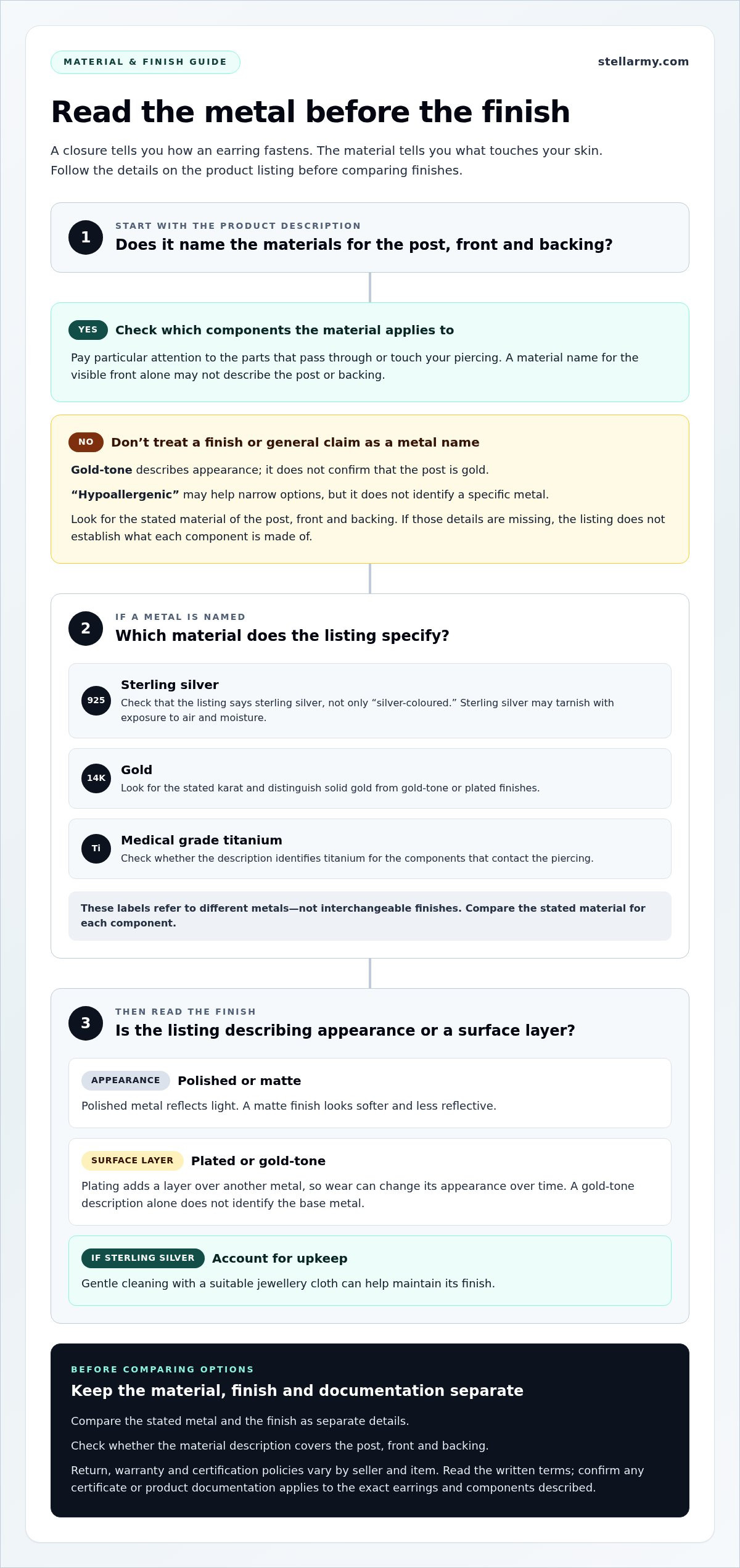
Screw-back earrings are available in sterling silver and materials marketed for sensitive ears in Malaysia. “Screw-back” describes the fastening mechanism, while the metal describes what touches your skin. Compare both details before choosing a pair.
Common choices include 925 sterling silver, 14K gold, and medical grade titanium. Sterling silver contains silver alloyed for jewellery use, while 14K gold is a gold alloy. Titanium is another material option. These labels identify different metals, not interchangeable finishes, so check the product description for the actual material.
For sensitive ears, focus on the post and backing as well as the visible front. A gold-tone surface doesn’t necessarily mean the post is gold. For example, a gold-coloured stud may have a different base metal beneath its finish. Prioritise clearly stated materials for the parts that pass through or touch your piercing.
Finishes affect appearance and upkeep. Polished metal reflects light, while a matte finish looks softer and less reflective. Plating adds a surface layer over another metal, so wear can change its appearance over time. Sterling silver may tarnish when exposed to air and moisture. Gentle cleaning with a suitable jewellery cloth can help maintain its finish.
- 925 sterling silver: Check that the description identifies the metal, rather than only saying “silver-coloured.”
- 14K gold: Look for the stated karat and distinguish solid gold from gold-tone or plated finishes.
- Medical grade titanium: Review whether the product description identifies titanium for the earring components that contact the piercing.
Terms such as “hypoallergenic” can help narrow your options, but they don’t identify a specific metal. Read the materials list and check whether it covers the post, front, and backing. If a listing gives only a finish, such as gold-tone, that describes appearance rather than the base material.
Return, warranty, and certification policies vary by seller and item. Read the written terms before buying, and make sure any material certificate or product documentation applies to the exact earrings and components described.
For style, compare small studs, decorative character earrings, and simple metal designs. A compact stud keeps the focus on the finish, while a decorative front changes the look without changing the backing mechanism. Choose based on the material touching your piercing, the finish you prefer, and how the earring feels when secured.
Product prices and shipping threshold
Compare earrings by their full specifications, not just the fastening. A screw-back and a flatback can use different metals, finishes, and decorative fronts. These details affect the price, so two earrings with similar silhouettes may not be directly comparable. In Malaysia, check the listed currency and whether the displayed amount applies to one earring or a pair.
The price depends on the case and is given after a quote request; cost factors include material, finish, design, and included components. For example, a 14K gold design and a sterling silver design differ in material, while a polished finish and a decorative stone can add separate product details. Compare the specifications alongside the price.
The same comparison applies to flatback earrings. Their price can reflect the metal, front design, and backing construction. A simple flatback stud and a more elaborate design may differ in price even when both use the same metal. Look for the stated material of the post, front, and flat disc, then compare like with like.
Shipping thresholds depend on each seller’s delivery policy, not the type of earring back. A threshold usually sets the order value required for a particular shipping benefit. Check whether it applies to the subtotal before discounts, the final basket value, or selected products only. These rules determine whether an earring order qualifies.
- Material: Compare stated metals, such as sterling silver, gold, or titanium.
- Finish: Separate a polished surface from plating or a gold-tone appearance.
- Design: Note whether a plain stud or decorative front changes the specification.
- Order terms: Review delivery charges and the seller’s threshold calculation.
Make a clear comparison before choosing. Record the material, finish, backing type, and whether the listing covers a pair. Then compare the total basket cost, including any stated delivery charge. For example, a lower-priced stud may not result in a lower-cost order if delivery is charged separately.
For screw-back and flatback earrings, read the product description for details about each component. A gold-coloured finish alone doesn’t identify the base metal. Likewise, a flat disc describes the backing shape, not the post material. Treat the product’s construction and the seller’s delivery terms as separate considerations.
In Malaysia, check the seller’s stated shipping threshold and currency at checkout. A threshold may change with promotions or product eligibility, so use the policy that applies to your current basket. Compare the final displayed total after applying eligible discounts and delivery terms.
For the Reese Flatback Stud, its component details can help keep comparisons precise: it has a 4 mm internal screw and a post length of 6 mm. These measurements describe the stud’s components, not its price or shipping eligibility. When comparing it with another listing, keep those details distinct from material, finish, and order terms, and check whether the other product gives comparable measurements. Evaluate the stated basket total and delivery conditions separately, so component dimensions do not stand in for a price or threshold comparison.
Earring back types
The back determines how an earring fastens and rests against your ear. A screw back threads onto a grooved post, while a push back slides onto a smooth post. A butterfly back uses a small metal clutch. A flatback has a flat disc behind the lobe, which can sit differently from a rounded clutch.
Compare the fastening mechanism with your daily routine. For example, frequent removal may make a simple push back easier to handle. A screw back requires turning the backing along the threaded post. Depending on the fit and your ear, a flatback’s disc may feel less prominent against the skin.
- Screw back: The backing twists onto matching threads. Align it carefully, then turn until secure without forcing it.
- Push back: A clutch slides onto the post. It’s quick to put on and remove, but the fit depends on the clutch and post.
- Butterfly back: Two curved sides grip the post. Its familiar shape may be easy to handle, though the clutch can press behind the ear.
- Flatback: A flat disc sits behind the ear. The front may attach by threading or another mechanism, so check the specific design.
These names describe different designs or components, not a universal comfort ranking. A tight butterfly clutch can feel less comfortable than a properly fitted screw back. A flat disc may suit one person’s lobe but feel awkward if the post is too long. Post length, backing shape, and earring weight all affect how it sits.
Use this fitting sequence when comparing pairs:
- Identify the post type, such as threaded or smooth.
- Match the backing to that post; incompatible parts won’t fasten correctly.
- Check that the backing rests against the ear without pinching.
- Move your head gently and notice whether the earring shifts or catches.
For screw backs, start the thread straight. If the backing resists, remove it and realign it instead of tightening harder. This keeps fastening controlled. The backing should hold the earring in place without being forced tightly against the lobe.
Consider practical use, too. Small parts can be harder to handle when you’re dressing quickly, while larger backs may be easier to grip. If you wear earrings overnight, you may prefer a less protruding back, but comfort still depends on the individual fit. Compare the front, post, and backing together rather than judging by appearance alone.
Earrings for sensitive ears
For sensitive ears, start with the metal that touches the piercing. A decorative front may use one material, while its post or backing uses another. Read the full materials description rather than relying on a colour such as silver or gold. For example, gold-tone describes appearance, not necessarily the metal beneath the finish.
Compare named materials carefully. Medical grade titanium, 14K gold, and 925 sterling silver are distinct material choices, not guarantees that every wearer will find them comfortable. Check whether the description covers the post, front, and back. That detail matters because each component can contact the ear during wear.
The backing also affects pressure. A screw back can feel uncomfortable if tightened too firmly against the lobe. A flat disc may rest differently from a rounded clutch. Check the fit gently: the backing should secure the earring without pinching or pressing hard against the skin.
- Read the component list: Look for separate descriptions of the post, decorative front, and backing.
- Prioritise contact points: Focus on the post and backing, not only the visible design.
- Check the finish: Distinguish solid material descriptions from plated or gold-tone finishes.
- Assess the fit: Notice pressure, rubbing, or catching while fastening the earring.
Keep a simple record if you experience discomfort. Note the earring material, backing style, and when you wore it. For example, record whether irritation appeared with a particular pair or after switching from a smooth post to a threaded one. These details can help you explain the issue clearly to a healthcare professional.
Keep your care routine gentle. Handle earrings with clean hands, keep the post and backing clean, and avoid forcing a tight closure. Use cleaning products only when their instructions are suitable for that jewellery material. A method intended for one finish may affect another, so follow the care directions for the specific pair.
- Identify the materials listed for every earring component.
- Choose a backing that sits comfortably without pressure.
- Fasten it gently and check that it doesn’t rub or catch.
- Stop wearing the pair if discomfort develops, and seek medical advice for ongoing symptoms.
Material labels help narrow your options, but fit is a separate consideration. Earrings made with medical-grade titanium can still feel uncomfortable if the post or backing presses against the lobe. Likewise, a comfortable closure doesn’t identify the metal. Evaluate material and fit separately.
For your first pair after a piercing, keep the design simple. A small stud can make it easier to notice how the post and backing sit. Once you know which materials and fastening styles suit you, compare more decorative fronts, including character designs, using the same component-by-component checks.
Screw-back earring security
Secure wear depends on straight threading, suitable post length, and gentle cleaning. Use these checks to avoid fastening errors and assess fit for children.
Safe Application and Tightening
To put on screw-back earrings safely, wash your hands and hold the earring by its front. Guide the post through the piercing, align the backing with the threads, then turn gently until it stays in place. Stop if the backing catches, feels forced, or presses tightly against the lobe.
Check that the front sits evenly and the backing doesn’t pinch. A secure fit shouldn’t require hard tightening. If the backing resists turning, remove it and realign it.
Size and Post Length Selection
Choose a post that passes through the piercing and leaves room for the backing without excessive movement. A post that’s too short can press against the lobe; one that’s too long may shift or catch. Compare the stated post length with your lobe thickness and the backing design.
Assess the front’s size and weight, too. A large decorative stud can pull differently from a small, lightweight one. Prioritise a stable, comfortable fit over appearance alone.
Child Suitability and Comfort
A screw back isn’t automatically safe or comfortable for every baby or child. Check the post length and backing pressure, and consider whether the child can leave the earring alone. Handle small detachable parts carefully around young children.
For a child’s piercing, an adult should handle the fastening and inspect the fit. Stop using earrings that pinch, loosen, or cause discomfort, and seek advice from a healthcare professional about persistent symptoms.
Cleaning and Care
Clean screw backs according to the care directions for their specific metal and finish. Wash your hands first, then gently clean the post and backing using a suitable method. Avoid forcing debris out of the threads with a sharp object, as this could damage the surface.
Keep each backing paired with its earring during cleaning. Dry the components thoroughly before fastening, and store them in a clean, dry place. For piercing-care guidance, see ear piercing aftercare instructions.
Before wearing a pair again, inspect the threads and backing. If the backing no longer turns smoothly or stays in place, don’t force it onto the post.
Stellar Malaysia: Ear Piercing
Stellar Malaysia offers ear piercing and earrings in 14K gold, 925 sterling silver, and medical grade titanium. If you’re weighing material, fit, and piercing choices together, its ear piercing service gives you a relevant next step. These options help you compare different metals while considering comfort for sensitive ears.
Explore earring materials and piercing information to decide what suits your needs. For guidance on ear piercing and jewellery options, visit stellarmy.com.
Choose a Pair That Fits Your Next Step
Your next step is to turn your preferences into a clear choice. Decide what matters most for regular wear: how the earring closes, how it feels against your ear, or how its material suits your skin. Then use those priorities to compare options instead of choosing by appearance alone. This makes it easier to find screw back earrings in Malaysia that suit your routine as well as your style.
If you’re also considering a new piercing, align the earring choice with that decision. Stellar Malaysia offers ear piercing, 14K gold earrings, and 925 sterling silver earrings. Exploring those options together can help you plan around the look and material you prefer.
Take the next step at your own pace. Contact Stellar Malaysia for help choosing an option that suits your needs, and move forward with confidence.
Frequently Asked Questions
What are the different types of earring backs?
Common types include screw backs, push backs, butterfly backs, and flatbacks. If you remove your earrings often, a push back can be quicker to handle. A screw back takes more turning, while a flatback may suit someone who prefers a flatter profile behind the ear. Compare the closure with your routine, and make sure the back matches the earring’s post.
How much do screw back earrings cost in Malaysia?
There’s no single standard price for screw-back earrings in Malaysia. Price depends on the case and is given after a quote request; cost factors include the metal, finish, design, and backing construction. For a fair comparison, match the stated materials and whether the listing covers one earring or a pair. Add any applicable delivery charge when assessing the total.
How do screw back earrings differ from push back earrings?
Screw backs fasten by turning onto a threaded post; push backs slide onto a smooth post and stay in place through friction. The practical difference is how you put them on and take them off. For example, a push back may be simpler for frequent changes, while a screw back requires careful alignment. With either type, check that the fit feels comfortable.