

The mall jewelry kiosk piercing vs boutique piercing salon choice usually comes down to the process, not the setting: a boutique salon is generally the better fit when you want an anatomy assessment, a hollow single-use needle, and tailored aftercare guidance. Kiosks may offer a quicker, walk-up experience, but piercing guns and limited consultation can make the experience different.
It’s reasonable to weigh convenience alongside comfort, jewellery, and hygiene before deciding. This guide compares the two options for ear piercing in Malaysia, including initial-wear materials, staff training, equipment, aftercare support, and what to expect during an appointment. You’ll get a clear way to judge which setting aligns with your priorities, without assuming every kiosk or salon follows the same approach. The key is understanding what each process involves and how those differences can affect your piercing experience.
Key Takeaways
- Compare initial-wear jewellery by material and suitability, not just appearance; the metal can shape comfort during healing.
- Clear aftercare guidance helps you understand how to care for a new piercing and recognise concerns that need attention.
- An anatomy assessment can help match jewellery placement and fit to your ear rather than relying on a one-size-fits-all approach.
- Understand how piercing guns and hollow single-use needles differ in their piercing method and potential effect on tissue.
- Use the appointment process as part of your decision: consider the consultation, hygiene practices, equipment, and support you receive.
1. Initial-wear jewellery materials
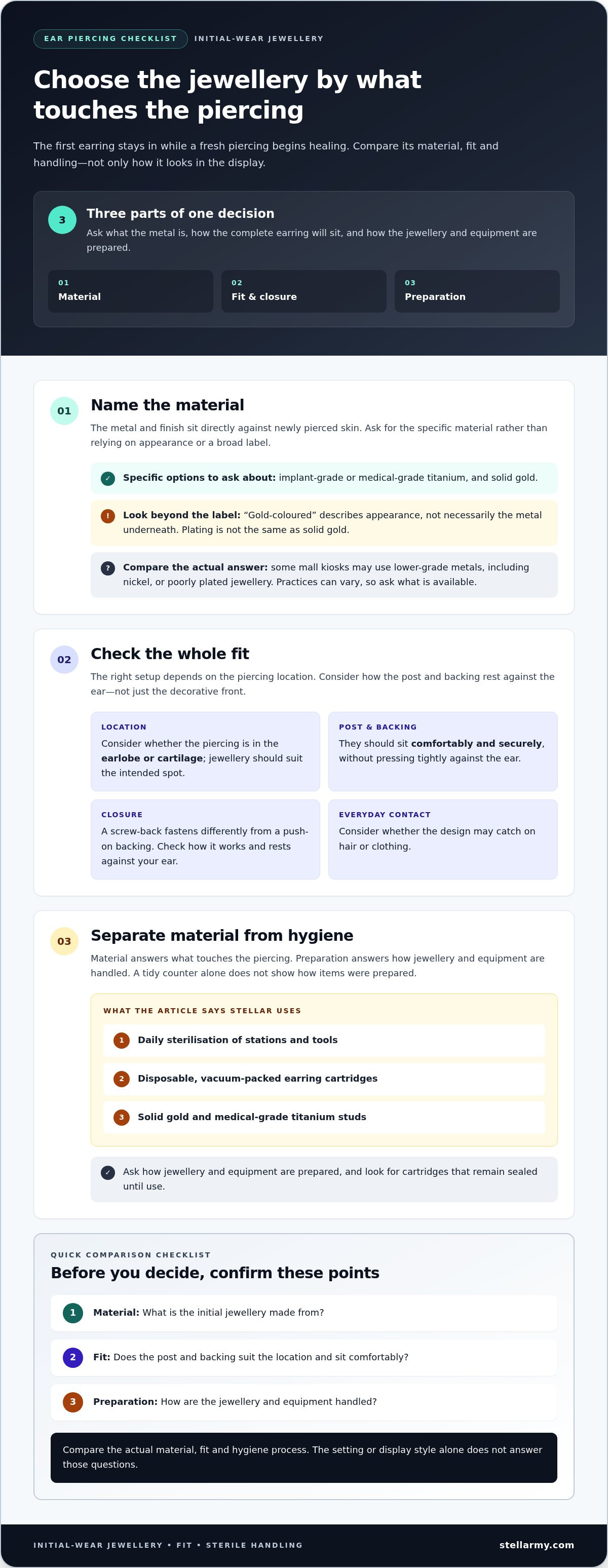
The first earring stays in place while a fresh piercing begins healing, so its material matters. Professional piercing studios use options such as implant-grade titanium and solid gold. Some mall kiosks may use lower-grade metals, including nickel, or poorly plated jewellery. The difference is not just appearance: the metal and finish sit directly against newly pierced skin.
Ask what the initial jewellery is made from instead of relying on a label such as “hypoallergenic” alone. A specific answer names the material, such as medical-grade titanium or solid gold. “Gold-coloured” describes appearance, not necessarily the metal underneath, and plating is not the same as solid gold. Knowing the material helps you compare earrings that look similar.
Fit matters as well as material. Jewellery should suit the piercing location, whether it is an earlobe or cartilage. The post and backing need to sit comfortably and securely without pressing tightly against the ear. When comparing options, consider where the piercing will be and how the complete earring will rest there, not just how the decorative front looks.
Consider the post, backing, and finish as one setup. A secure backing helps keep the earring in place, while a design that catches on hair or clothing may be inconvenient. A screw-back fastens differently from a push-on backing, so look at how the closure works and how it sits against your ear. Don’t choose solely by the decorative front; the post passes through the piercing.
Sterilisation is a separate consideration from material. At Stellar, stations and tools are sterilised daily, and disposable, vacuum-packed earring cartridges are used. Ask how the jewellery and equipment are prepared, and look for cartridges that remain sealed until use. A polished surface or tidy counter alone does not show how items were handled.
Sterile handling is essential when comparing ear-piercing services. A clean-looking counter does not tell you whether tools and jewellery have been properly prepared. Material and hygiene address different questions: what touches the piercing, and how the equipment is handled. At Stellar, daily sterilisation of stations and tools is paired with disposable, vacuum-packed earring cartridges.
For the mall jewelry kiosk piercing vs boutique piercing salon decision, compare the actual jewellery material, fit, and hygiene process. Stellar offers solid gold and medical-grade titanium studs, and uses disposable, vacuum-packed cartridges alongside daily sterilisation of stations and tools. Ask what material is available and consider whether the post and backing suit the intended piercing. Specific answers are more useful than judging by display style.
2. Piercer guidance and personalised aftercare
A piercing appointment should cover more than placement and jewellery selection. It should also give you a chance to understand the process and ask questions about aftercare. At Stellar, complimentary consultations are available, with two free consultations per customer, and aftercare lotion is included in the piercing package. The visit includes professional lobe or cartilage piercing by a certified technician.
In Malaysia, don’t assume one age or parental-consent rule applies equally to ear and body piercing. For a minor, involve a parent or guardian and establish the consent requirements before booking; discuss ear and body piercing separately rather than treating them as the same procedure.
Before leaving, make sure the instructions cover your specific piercing, not just general ear care. An earlobe and a helix sit in different areas and can face different pressure from headphones, hair, or clothing. A useful aftercare explanation should give you clear steps, explain what to avoid, and tell you how to raise concerns. If the instructions are only verbal, ask for a written version you can refer to later.
Follow-up access also matters. Professional piercers can answer questions after the appointment, which is useful if you’re unsure whether a change needs attention. For example, ask what to do if a backing feels tight or the area becomes increasingly uncomfortable. Don’t rely on a friend’s experience as a substitute for advice about your own piercing. Its placement, jewellery, and healing response affect the guidance that fits.
Following the aftercare instructions is an important part of looking after a new piercing. Before you leave, make sure you understand the guidance and know how to raise a concern. Stellar includes aftercare lotion with its piercing package, and the consultation gives you an opportunity to ask questions about the process and care.
- How to follow the recommended cleaning routine.
- Which habits or contact may irritate the piercing.
- What changes call for a follow-up question or concern.
Keep the instructions accessible at home, and follow the steps consistently rather than changing products or routines on impulse. If you’re comparing a kiosk and a boutique salon, compare the quality of the explanation, not just the appointment’s speed. A clear ear piercing aftercare guide can help you revisit care instructions after your appointment.
3. Piercer training and anatomy assessment
A piercing appointment should begin with considering the ear and the intended placement, not choosing a spot from a template. At Stellar, certified technicians perform ear-lobe and cartilage piercings using an advanced hand-pressure instrument. Ask how the placement and jewellery suit the specific location you want.
Anatomy matters for both comfort and styling. An earlobe offers a different placement surface from the helix, the cartilage along the upper ear. A forward helix sits near the front edge. Each location has distinct contours and available space. An assessment should consider the intended piercing site, surrounding tissue, and how jewellery will sit when your ear is relaxed.
Placement shapes the final look. Two people requesting a helix piercing may have different ear contours, so a position that suits one person may not suit another. Discuss the intended location and jewellery with the technician, rather than copying a reference photo without considering how the piercing will sit on your ear.
Training matters throughout the appointment, not only when placement is marked. Stellar’s piercing technicians are certified after completing an intensive training course. Ask the technician to explain the planned location, the instrument, and the jewellery before proceeding. A clear explanation helps you understand the decisions being made for your piercing.
In Malaysia, ask who will perform the piercing, what training they have, how they assess your ear, and how they choose placement and jewellery. Also ask what tool they’ll use and how they handle concerns after the appointment. Clear answers should address the specific site you want, such as a lobe or helix, rather than offering only a general explanation.
During a consultation, pay attention to the steps before the piercing. The piercer should examine the intended area, discuss your preferred placement, and consider whether the jewellery fits that location. You should have a chance to review the marked position before proceeding. If you’re choosing a forward helix, for example, the placement needs to suit the ear’s front cartilage and the jewellery’s position.
Use these points to compare a kiosk and a boutique salon:
- Whether the piercer assesses your individual ear before marking a location.
- Whether the placement discussion covers the specific site you want.
- Whether jewellery fit is considered alongside appearance.
- Whether the piercer can explain relevant anatomy and possible complications.
These checks help distinguish a personalised discussion from a quick transaction. A useful consultation connects the intended location, jewellery, and piercing process. Stellar offers complimentary consultations so you can discuss those choices before a lobe or cartilage piercing.
4. Piercing guns compared with hollow needles
The tool changes how an ear piercing is made. Many mall piercings use a piercing gun, which pushes jewellery through skin using blunt force. Professional piercers use hollow, single-use needles instead. That difference matters because each method acts on tissue differently, even when both create a piercing in the same location.
Different instruments work in different ways, so ask what will be used before the procedure. Stellar uses an advanced hand-pressure instrument, not a spring-loaded device, and it makes almost no sound. The technique, jewellery, and preparation process should be clear before you agree to proceed.
A hollow needle creates the opening through the skin, and professional piercers use a fresh, single-use needle for each piercing. The needle is discarded after use rather than used again for another person. Compared with a piercing gun, professional piercing needles cause less tissue trauma and support faster healing with fewer complications. This makes the instrument itself a key part of comparing piercing methods.
Ask what tool will be used before the procedure begins. Get a direct answer: a piercing gun or a hollow, single-use needle. If the answer is “a needle,” clarify that it’s hollow and single-use. If jewellery is loaded into a device, ask whether that device pushes the jewellery through the skin. The method should be clear before you agree to proceed.
For a practical comparison, focus on the method and its likely tissue effects:
- Piercing gun: Pushes jewellery through skin with blunt force and can cause tissue trauma, swelling, bruising, or slower healing.
- Hollow needle: Used by professional piercers as a single-use instrument; it causes less tissue trauma and supports faster healing with fewer complications than a gun.
- Before proceeding: Identify the instrument, confirm whether the needle is single-use, and understand how the piercing will be made.
The intended location also shapes what to discuss. For an earlobe or helix piercing, ask about the instrument, the jewellery, and how equipment is prepared. At Stellar, certified technicians use an advanced hand-pressure instrument and disposable, vacuum-packed cartridges. Don’t assume the method from the venue; ask what the process involves.
The mall jewelry kiosk piercing vs boutique piercing salon decision becomes clearer when you compare the actual technique, not just the venue. A boutique setting may use a hollow, single-use needle, while many mall piercings use guns. Focus on the instrument, how it contacts tissue, and the expected healing implications. That gives you a concrete basis for deciding which approach better fits your priorities.
5. Piercing studio and appointment experience
A piercing appointment is a sequence, not just the moment jewellery goes in. Notice how the provider manages arrival, consultation, preparation, placement, and aftercare instructions. A mall kiosk may offer a walk-up transaction, while a boutique salon may structure the visit around a consultation. The setting alone doesn’t prove quality, so assess what happens at each step.
Start with the consultation. You should have the opportunity to discuss the piercing you want, the intended placement, and the jewellery before the procedure begins. Someone considering a helix piercing, for example, can ask how the jewellery will suit that location. Stellar offers complimentary consultations, with two free per customer.
Next, consider the preparation. At Stellar, stations and tools are sterilised daily, and disposable earring cartridges are vacuum-packed. Ask how the equipment is handled and check that a cartridge remains protected until use. A tidy counter alone does not show the preparation process, so look for a clear explanation of the actual hygiene steps.
Pay attention to how the appointment proceeds. The technician should explain the planned steps and give you an opportunity to discuss the intended location and jewellery. At Stellar, certified technicians perform ear-lobe and cartilage piercings using an advanced hand-pressure instrument. Ask questions before proceeding if anything is unclear.
The after-appointment handoff is another useful comparison point. Before leaving, you should know what care instructions to follow and how to raise a concern. A printed guide or clear written instructions can help you remember the steps once you’re home. If you’re unsure about a direction, ask for it to be explained again before the appointment ends.
Compare the experience using specific observations:
- Does the consultation cover your requested piercing and placement?
- Can you observe a clear preparation process before the piercing?
- Does the piercer explain each step and allow time for questions?
- Do you leave with understandable aftercare instructions?
These checks help you compare a quick transaction with an appointment that includes time for discussion. What matters is whether you can understand the process, equipment, and aftercare before proceeding. Stellar offers complimentary consultations, with two free per customer, and professional lobe and cartilage piercing by certified technicians.
For a Malaysia appointment, plan around the piercing location you want and the questions you need answered. Write down your preferred placement, jewellery concerns, and any aftercare questions before arriving. This simple preparation keeps the conversation focused, whether you’re considering a mall kiosk or boutique salon. Your decision can then reflect the actual appointment experience, not just the venue’s appearance.
Stellar Malaysia: Ear Piercing
Stellar Malaysia offers ear piercing for readers who want a dedicated setting for their appointment and jewellery choice. Its ear-piercing consultations can help you consider placement and suitable earrings, including 14K gold, 925 sterling silver, and medical-grade titanium options.
This is a natural next step if you’re comparing kiosk and boutique experiences and prefer to discuss your ear-piercing needs before choosing jewellery. Explore the ear-piercing service to learn more about the appointment. Visit Stellar Malaysia online to explore its ear-piercing service.
Make Your Next Piercing Choice With Confidence
Use your appointment to make an informed choice, not simply complete a purchase. Consider the piercing location, jewellery, and process, and ask questions if anything is unclear. Stellar offers complimentary consultations and professional ear-lobe and cartilage piercing by certified technicians. Book an appointment to discuss your piercing and jewellery options.
For readers considering a boutique ear-piercing experience in Malaysia, Stellar Malaysia offers ear piercing alongside 14K gold earrings and 925 sterling silver earrings. Explore those options as you plan your appointment and consider which jewellery best matches your preferences. The key distinction in the mall jewelry kiosk piercing vs boutique piercing salon decision is how well the process fits your priorities, from the first conversation to the jewellery you choose.
Contact Stellar Malaysia today to take the next step toward your ear-piercing appointment. Choose thoughtfully, ask the questions that matter to you, and move forward feeling prepared.
Frequently Asked Questions
What is the difference between mall jewelry kiosk piercing and boutique piercing salon services?
The appointment format and piercing process vary by provider. Compare the actual steps rather than relying on the venue’s appearance: ask what instrument is used, how equipment and jewellery are prepared, and what aftercare guidance is included. At Stellar, certified technicians perform lobe and cartilage piercings using an advanced hand-pressure instrument, with daily sterilisation and disposable, vacuum-packed cartridges.
Which piercing method is safer: piercing gun or sterile single-use needle?
A sterile, hollow single-use needle is generally the better choice than a piercing gun. Professional piercers use these needles to create the opening, while guns push jewellery through skin using blunt force. That force can cause tissue trauma, swelling, bruising, and slower healing. Ask what tool the provider uses and whether a needle is hollow and discarded after the procedure. The method should be clear before you proceed.
What hygiene and sterilization standards should a piercing provider follow in Malaysia?
Focus on observable hygiene practices rather than assuming a particular standard from the venue. Ask how tools and jewellery are sterilised; professional piercing studios use autoclaves. Notice whether prepared items stay protected until use, and whether the work area is organised before your appointment. A clean-looking counter alone doesn’t establish that instruments were sterilised. The provider should be able to explain the preparation process clearly and specifically.
What jewelry materials are recommended for new piercings, such as implant-grade titanium or gold?
Implant-grade titanium and solid gold are materials used for initial piercing jewellery. Ask for the material name, not just a colour or “hypoallergenic” label, and consider how the post and backing fit your piercing location. For example, jewellery intended for an earlobe may not suit a helix placement. A clear material description helps you compare options and avoid assuming plated jewellery is solid gold.
What are the infection, scarring, and healing risks of kiosk and salon piercings?
Good hygiene, clear aftercare guidance, and an informed choice of jewellery all matter when considering a piercing. At Stellar, stations and tools are sterilised daily, disposable, vacuum-packed cartridges are used, and aftercare lotion is included in the piercing package. Follow the instructions provided and raise concerns with a professional rather than relying on guesswork.