
Most crowded ear stacks aren't a personal style failure; they're the direct result of treating complex ear anatomy like a blank canvas rather than structural architecture. If you've ever struggled with unbalanced placements from past impulse piercings or chronic irritation from mystery alloys, you already know how difficult it is to build a cohesive look on your own. Scheduling a professional konsultasi gaya telinga replaces that frustrating trial-and-error approach with an intentional, anatomically calibrated curation plan.
A professional styling consultation evaluates your distinct cartilage contours, daily lifestyle, and aesthetic preferences to engineer a bespoke ear stack using certified biocompatible materials like medical-grade titanium and solid gold. You'll discover how to correct spatial imbalances, select nickel-free metals that protect delicate skin, and establish a phased implementation roadmap designed for optimal healing. This guide breaks down the precise blueprint behind professional ear curation, giving you the clarity to build a striking, enduring collection with total confidence.
Key Takeaways
- Anatomical mapping during a professional konsultasi gaya telinga prevents crowded placements and aligns each piercing to your unique cartilage contours.
- Visual mapping and precise physical marking establish a balanced, phased blueprint for complex lobe, helix, and forward helix combinations.
- Selecting certified biocompatible metals such as medical-grade titanium and 14K or 18K gold eliminates nickel-induced irritation and supports seamless healing.
- Clinical aftercare protocols protect your aesthetic investment by avoiding harsh cleansers in favor of dedicated, sterile solutions.
- Strategic pre-session preparation, from curating reference imagery to maintaining proper appointment readiness, ensures a smooth and productive styling experience.
What Is a Konsultasi Gaya Telinga and Why Does Placement Matter?
Search results frequently confuse ear consultations with clinical ENT examinations for hearing health. A modern konsultasi gaya telinga is something entirely different: a deliberate architectural mapping session designed for multi-piercing curation. Rather than treating piercings as standalone impulse purchases, a professional consultation views your ear as an asymmetrical, structural landscape where millimeters dictate both visual harmony and long-term tissue integrity.
Throughout the broader history of body modification, adornment has evolved from basic puncture work into a precise anatomical discipline. Spontaneous walk-in sessions often bypass this reality. When piercers don't evaluate how multiple piercings interact over time, clients face crooked entry angles, persistent swelling, and mismatched jewelry that clashes during everyday wear. Professional curation replaces impulse with structural intention.
The Core Principles of Curated Ear Architecture
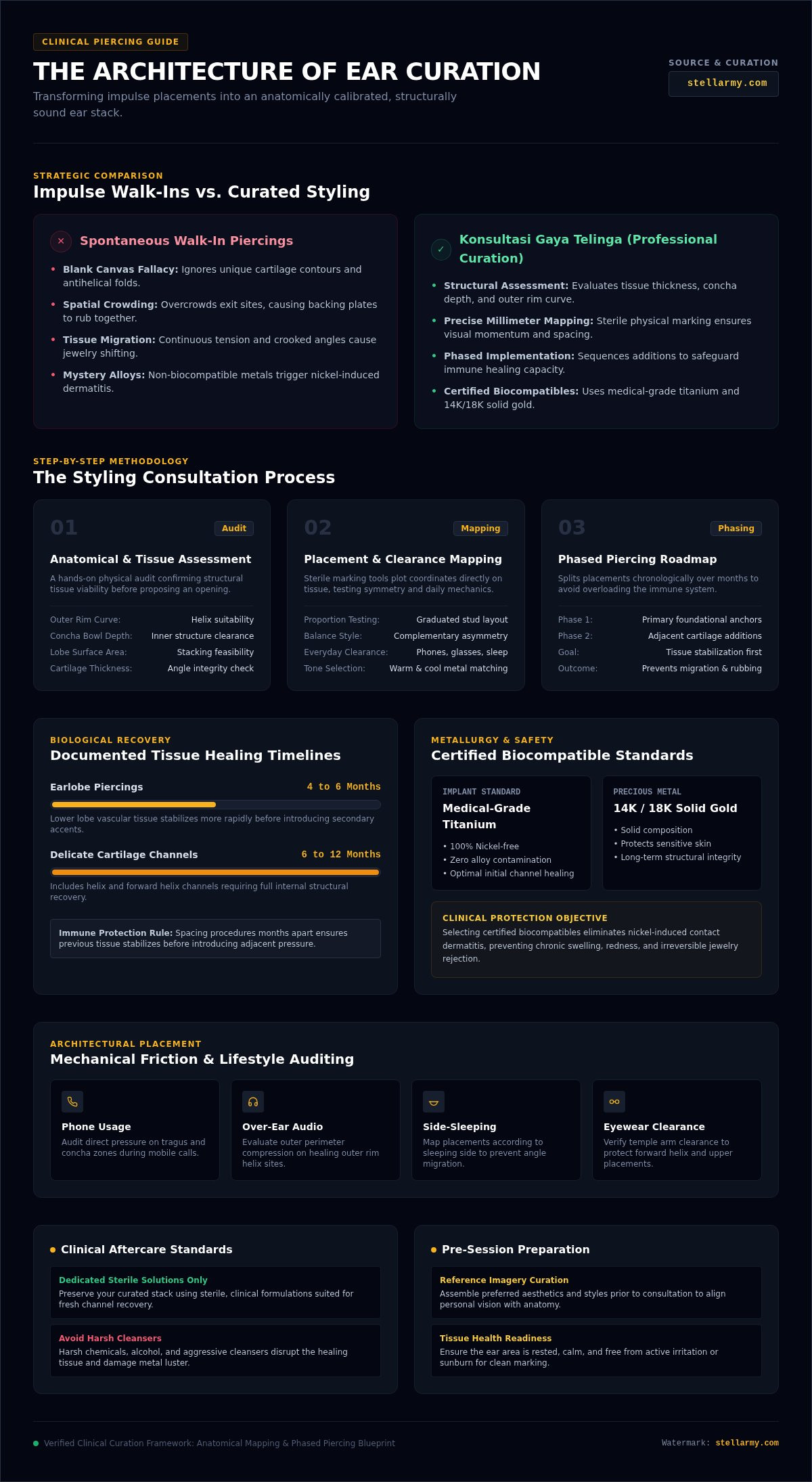
Effective curation begins with structural evaluation rather than jewelry selection. An expert stylist analyzes your cartilage ridges, antihelical folds, and earlobe proportions before proposing an opening. They establish deliberate focal points, anchoring bolder pieces along the lower lobe while balancing the upper rim with delicate accents. This blueprint also accounts for your daily routine, factoring in side-sleeping habits, telephone usage, and over-ear headphone pressure to ensure mechanical friction doesn't disrupt delicate healing tissue.
Moving Beyond Random Walk-In Piercings
Impulse piercings rarely build a cohesive stack. Without a strategic roadmap, sequential walk-ins often crowd exit sites, causing backing plates to rub together or jewelry to migrate under continuous tension. Structured ear styling resolves this by phasing additions across multiple appointments. Through professional piercing services, stylists plan placements months in advance, spacing cartilage procedures so previous tissue stabilizes before introducing adjacent pressure. This phased approach guarantees that every lobe, helix, or forward helix placement heals cleanly while contributing to a unified aesthetic.
The Step-by-Step Ear Styling Consultation Process
A structured konsultasi gaya telinga eliminates the trial-and-error of random appointments. While hospital directories often frame ear visits around medical intake forms, professional ear curation functions as an architectural assessment. Stylists systematically evaluate cartilage thickness, baseline tissue health, and personal aesthetics to construct an actionable, beautiful blueprint.
Comprehensive Anatomical and Tissue Assessment
Every session begins with a hands-on physical audit. Stylists assess your ear's unique landscape, examining the curvature of the outer rim, the depth of the concha bowl, and the available surface area on your earlobes. This anatomical audit confirms whether your tissue supports specific placements, such as an angled forward helix piercing, a stacked lobe piercing, or an elevated helix piercing. Catching structural limitations early prevents jewelry from settling crookedly or exerting undue pressure on underlying cartilage.
Virtual and Physical Jewelry Placement Mapping
Once anatomy is verified, the visual engineering begins. Stylists use specialized, sterile marking tools to plot exact coordinates directly on your ear, testing millimeter spacing and line-of-sight balance. Rather than enforcing rigid symmetry across both ears, stylists often curate cohesive, complementary asymmetry tailored to your personal aesthetic.
- Proportion testing: Placing graduated studs along the lower lobe to build visual momentum.
- Mechanical clearance: Checking clearance around glasses, hair, and mobile devices before piercing.
- Material pairing: Auditing certified biocompatible materials for your signature stack, matching cool or warm metal tones to your complexion.
Designing a Phased Piercing Schedule
Executing an entire curated concept at once compromises your immune system and prolongs healing. A professional consultation breaks your ideal stack into a disciplined timeline. Earlobe piercings generally heal within four to six months, whereas delicate cartilage channels require six to twelve months of recovery. Stylists sequence placements chronologically, stabilizing primary foundational anchors before adding intricate upper-ear accents.
Spacing additions over several months ensures each channel recovers comfortably without excessive swelling or friction. If you're ready to transition from haphazard piercings to an intentional aesthetic plan, booking a professional piercing service gives you direct access to this structured design framework. You can secure your dedicated styling session with an ear piercing appointment deposit to begin mapping your custom configuration.
Selecting Biocompatible Materials for Your Signature Stack
A successful ear stack depends as much on metallurgy as it does on spatial geometry. During a comprehensive konsultasi gaya telinga, evaluating biocompatibility serves as the non-negotiable baseline for tissue stability. Substandard fashion metals frequently leach nickel salts into newly formed fistula channels. This triggers allergic contact dermatitis, excessive lymph fluid buildup, and persistent swelling. Even the most balanced design collapses if chronic inflammation forces you to retire an irritated piercing prematurely.
Mechanical closure architecture matters just as much as alloy purity. Initial piercings require dedicated labret posts rather than generic butterfly backs that harbor bacteria and trap moisture. Professional stylists rely on threadless push-pin posts or internally threaded screw-backs engineered with mirror-polish finishes. Aligning with benchmarks highlighted in the NEHA guidelines on piercing safety, these flush structural designs eliminate micro-tears against raw tissue channels during daily movements.
Medical Grade Titanium and Solid Gold Standards
Medical grade titanium earrings represent the benchmark for initial channels due to an inert oxide surface that completely resists corrosion. For elevated stacks, solid 14K gold earrings and dedicated 18K gold piercing studs deliver refined luxury alongside proven tissue compatibility. These solid alloys won't chip or degrade over time. In contrast, gold-plated or vermeil pieces break down under constant friction and moisture, inevitably exposing reactive base metals to vulnerable cartilage.
Sterling Silver and Specialized Accent Pieces
Once tissue fully stabilizes, your aesthetic rotation expands. Refined 925 sterling silver earrings introduce a bright, contemporary contrast across healed lobe channels. Collectors can also incorporate curated accents, such as Disney piercings and Disney characters earrings, into healed sections without compromising tissue health. A professional stylist calculates the structural weight and mechanical leverage of these decorative motifs, confirming that hanging elements don't exert downward torque on delicate cartilage borders.
Aftercare Protocols: Preserving Your Curated Ear Investment
Precision placement only succeeds when paired with disciplined recovery protocols. A thorough konsultasi gaya telinga doesn't conclude when the jewelry clicks into place; it extends into post-procedure preservation. Substandard aftercare routines jeopardize your aesthetic blueprint, turning balanced alignments into swollen, shifted angles caused by chronic irritation bumps or tissue degradation.
Avoid dated home remedies entirely. Harsh substances like rubbing alcohol, hydrogen peroxide, and tea tree oil dry out newly forming epithelial tissue, stalling cellular regeneration. Rotating or twisting your jewelry also tears the delicate internal fistula. Maintaining a hands-off approach protects the pristine structural foundation established during your appointment.
Daily Cleaning and Hygiene Routines
Effective hygiene requires gentle consistency. Mist the entry and exit points twice daily with an isotonic saline wash to flush crust and cellular debris without stripping essential moisture. After cleansing, thoroughly dry the area using sterile non-woven gauze pads, as damp environments encourage bacterial buildup behind decorative ends. You can inspect complete step-by-step guidance on proper piercing aftercare to keep your recovery strictly on track.
Managing Downsizing and Healing Milestones
Initial posts feature extra length to accommodate localized swelling during early recovery stages. Leaving these extended labret bars in place indefinitely invites disaster. Once early swelling subsides, excess bar length allows the jewelry to tilt under routine contact, permanently altering the perpendicular angle of the piercing channel.
- Lobe healing windows: Primary earlobe tissue generally stabilizes over four to six months. Maintain continuous jewelry wear to keep channels open.
- Cartilage timelines: Structural areas like the helix or forward helix demand six to twelve months of uninterrupted healing.
- Post downsizing: Return to your stylist around the designated six-to-eight-week mark to swap long starter posts for snug, flush-fitting hardware.
- Mechanical protection: Sleep with a dedicated travel or donut pillow to prevent direct cranial pressure against healing cartilage.
Protecting your aesthetic curation requires clinical vigilance from day one. To safeguard your delicate piercings with formulated solutions and structured healing advice, review our complete aftercare guidelines and support protocols to preserve your curated investment permanently.
How to Prepare for Your Professional Ear Styling Session
Spontaneous appointments rely on luck, but a successful konsultasi gaya telinga relies on deliberate preparation. Unlike clinical hospital check-ins that involve rigid diagnostic registration, preparing for an aesthetic curation session centers on physical stamina, lifestyle alignment, and realistic visualization. Arriving prepared ensures a seamless transition from concept mapping to precise procedural execution.
Physical readiness directly impacts procedural comfort and tissue response. Eat a balanced, protein-rich meal and hydrate thoroughly one to two hours before your appointment. Steady blood glucose levels prevent sudden vasovagal drops, reducing lightheadedness during needle placement. Wear loose button-down tops or wide-neck shirts rather than tight crewneck sweaters that risk snagging against freshly placed jewelry when undressing.
Curating Your Visual Moodboard Realistically
Bring three to five visual references, but maintain structural flexibility. Cartilage contours vary drastically across individuals. A placement that looks striking on a wide, flat scapha might not fit a narrower ear rim. Group your inspirational imagery by preferred metal palettes, whether you favor warm 14K yellow gold or crisp medical-grade titanium. Clarify your immediate additions versus long-term curation goals so your stylist can prioritize foundational piercings first.
Securing Your Personalized Styling Experience
Professional styling studios maintain clinical hygiene standards, employing single-use sterile instrumentation and rigorous aseptic protocols. Arrive with clear details regarding your daily routines, including helmet use, sports habits, or past alloy sensitivities, so your stylist can engineer around these lifestyle factors.
Dedicated studios schedule curation sessions in advance to allocate focused time for detailed anatomical mapping. You can reserve your dedicated session by submitting an ear piercing appointment deposit. Clarifying your visual direction and physical readiness beforehand guarantees you maximize every minute of your consultation, leaving with a cohesive, enduring ear stack.
Elevate Your Ear Stack With Anatomical Precision
A striking ear stack is never an accident of impulse; it's the product of architectural planning and disciplined restraint. Prioritizing anatomical mapping ensures every placement complements your natural cartilage contours, while certified biocompatible metals like medical-grade titanium and 14K gold safeguard long-term tissue integrity. Approaching curation through a structured, phased roadmap gives delicate channels the space they need to recover cleanly.
Scheduling a professional konsultasi gaya telinga eliminates the aesthetic frustration and physical irritation of trial-and-error piercings. Nationwide piercing specialists at Stellar Malaysia pair strict clinical hygiene and single-use sterile instrumentation with tailored anatomical mapping to engineer balanced, personal designs. You don't have to navigate metal choices and spacing angles alone. Book your bespoke ear styling consultation at Stellar Malaysia today to start crafting a cohesive, enduring signature stack.
Frequently Asked Questions
What is the primary difference between ear styling and standard ear piercing?
Standard ear piercing focuses purely on executing a single puncture at a chosen spot. In contrast, a comprehensive konsultasi gaya telinga evaluates your complete ear landscape, aligning multiple placements with your natural cartilage contours, personal style, and everyday habits. It treats your ear as an integrated curation rather than a series of disconnected, impulse additions.
Can any ear anatomy accommodate advanced cartilage piercings like a forward helix?
No, not every ear can safely support advanced placements. A forward helix piercing requires a defined, distinct cartilage rim with adequate depth to anchor the jewelry securely. If the tissue fold is too flat or shallow, the post will tilt under continuous tension. Stylists identify these biological limitations during the initial assessment to protect tissue health.
How many ear piercings should I get during a single styling consultation?
Professional stylists generally recommend limiting new piercings to no more than two or three per session. Healing multiple channels simultaneously taxes your immune system, which prolongs swelling and increases irritation risks. Sticking to one ear at a time also ensures you have an unbothered side to sleep on comfortably during the initial recovery months.
Which jewelry metal is best recommended for sensitive ears during initial styling?
Medical grade titanium earrings are the gold standard for clients prone to metal sensitivities. This inert metal is completely nickel-free and resists corrosion from bodily fluids. Solid 14K gold earrings and 18K gold piercing options also provide exceptional tissue compatibility for initial channels. Stylists strictly avoid plated metals until channels have matured entirely.
How long does a full curated ear stack take to complete and heal?
Building a cohesive ear stack usually takes between twelve and eighteen months of phased appointments. Earlobe tissue heals relatively quickly within four to six months, while complex cartilage placements take six to twelve months to stabilize. Spacing appointments around these physiological milestones prevents mechanical interference between adjacent piercings and ensures enduring structural comfort.
Can I incorporate my existing earrings into a new curated ear styling design?
Yes, bringing your favorite pieces into a konsultasi gaya telinga is standard practice. Stylists frequently design around meaningful existing jewelry, using pieces like 925 sterling silver earrings or studs to balance new additions. As long as your existing piercings are fully stabilized and the metals are high quality, stylists will integrate them into the overall blueprint.
What should I do if my ear anatomy cannot support my preferred piercing placement?
Trust your stylist's recommendations to pivot toward alternative placements that offer a similar aesthetic effect. If your cartilage ridge cannot support an industrial or forward helix, a stacked lobe piercing, conch accent, or faux-rook placement can mirror that visual balance. Professional curation adapts creative design concepts to match your real anatomy without risking chronic rejection.