
Is that persistent throbbing in your earlobe a standard healing response or the start of a permanent scar? With local data showing that improper techniques lead to complications in one out of ten cases, you can't afford to guess. Identifying the specific ear piercing infection signs malaysia presents is the first step in protecting your aesthetic investment and your health.
You're right to feel concerned about sudden swelling or heat around your jewelry. Malaysia's 80% average humidity creates an aggressive breeding ground for bacteria, making standard aftercare insufficient for many. This guide provides the elite safety protocols you need to distinguish between minor irritation and a high-stakes infection. You'll learn how to stop the pain, avoid keloid formation, and understand the professional standards required by the 2026 Medical Device Order. We'll outline exactly when home care is enough and when it's time to seek a medical professional to ensure your recovery is as precise as your piercing.
Key Takeaways
- Learn how to identify the critical ear piercing infection signs malaysia residents face, including localized heat and persistent throbbing that lasts beyond 48 hours.
- Discover the essential differences between common metal allergies and true bacterial infections to avoid unnecessary medical costs.
- Understand how Malaysia's high humidity levels accelerate bacterial growth and why specialized aftercare is non-negotiable for healing.
- Get the professional protocol for managing minor infections at home, including why you should never remove your jewelry prematurely.
- Identify the elite safety standards, such as medical-grade titanium and 14K gold, that prevent complications before they start.
Recognizing Ear Piercing Infection Signs in Malaysia
Identifying ear piercing infection signs malaysia requires a clinical approach to your post-piercing recovery. While some level of tenderness is expected during the first 48 hours, an infection is a distinct failure of the healing process that demands immediate intervention. In our tropical climate, bacteria thrive in high humidity, making it vital to distinguish between standard inflammation and a developing complication before permanent tissue damage occurs.
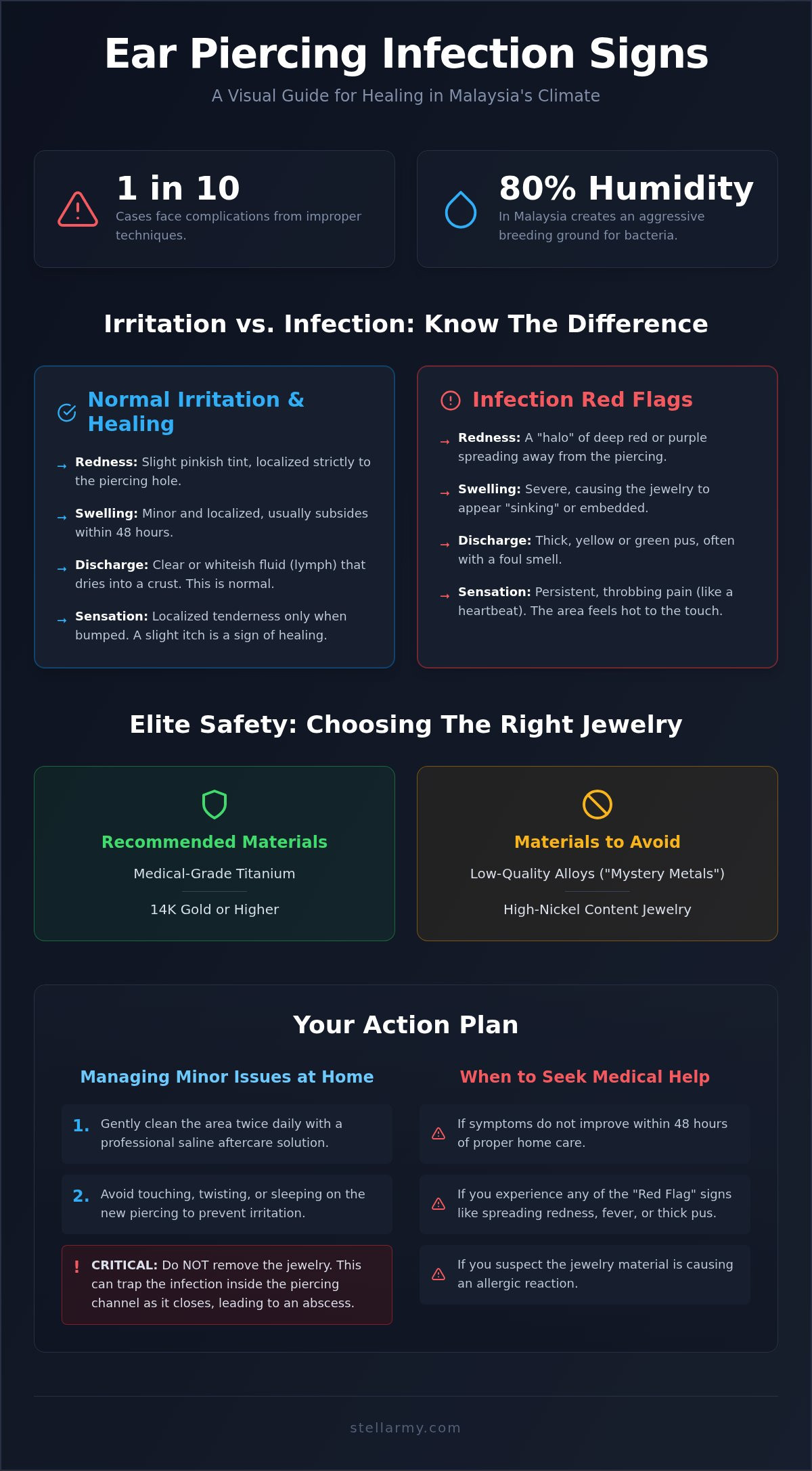
A primary indicator of trouble is persistent redness that migrates. Normal healing involves a slight pinkish tint localized strictly to the entry and exit points. If you notice a "halo" of deep red or purple skin expanding in a circular pattern away from the jewelry, the infection is likely spreading through the surrounding tissue. This visual cue often coincides with swelling so severe that the earring post appears to be "sinking" or becoming embedded in the earlobe. If your jewelry feels tight or the skin is beginning to swallow the butterfly back, your ear is in a state of high-stakes distress.
Visual Symptoms: What to Look For
An infected piercing represents an acute immune response to a bacterial invasion within the dermal layer. To manage this effectively, you must monitor the type of fluid your ear produces. Clear or slightly white fluid that dries into a "crustie" is typically lymph, a sign of healthy tissue repair. However, active oozing of thick, yellow, or green pus is a definitive sign of infection. This discharge is often accompanied by a dull, matte appearance of the skin rather than the healthy glow of healing tissue.
Understanding body piercing risks is essential for anyone pursuing ear curation. While many assume crustiness is always bad, it is the transition from dry crusting to wet, foul-smelling discharge that signals a breach in your sterile field. If you are wearing low-quality mystery metals, this visual irritation might actually be a systemic rejection, which is why elite studios prioritize medical-grade titanium or 14K gold to eliminate material-based variables.
Physical Sensations: The Pain Scale
The sensation of your piercing provides the most honest data about its health. You should not feel constant, radiating pain while sitting still. If you experience a persistent throbbing that synchronizes with your heartbeat, the internal pressure from trapped fluid is reaching a critical level. This is fundamentally different from the localized tenderness felt only when the area is accidentally bumped.
Temperature is another high-fidelity trust signal. An infected ear often feels hot to the touch or radiates heat that you can feel without even using your hands. While a slight itch can indicate the skin is knitting back together, a burning sensation combined with heat usually points to a bacterial presence or a severe nickel allergy. If these sensations don't subside after a thorough cleaning with a professional saline aftercare solution, your piercing's structural integrity is at risk. Precision in monitoring these sensations allows you to move from uncertainty to decisive action, ensuring your ear health remains uncompromised.
Irritation vs. Infection: How to Tell the Difference
Distinguishing between simple irritation and genuine ear piercing infection signs malaysia is critical for avoiding unnecessary medical interventions. Many people panic at the first sight of redness, but in a high-humidity environment like Kuala Lumpur, your skin reacts differently to external stressors. Physical trauma from snagging a piercing on a face mask or hairbrush often causes localized inflammation that mimics the early stages of an infection. However, trauma-induced swelling usually subsides within 48 hours if the area is kept clean and undisturbed.
If you notice your jewelry shifting position or the skin between the entry and exit points becoming thinner, you're likely experiencing migration or rejection. This is a structural failure of the tissue, not necessarily a bacterial one. Similarly, small bumps known as granulomas frequently appear around cartilage piercings. These are trapped pockets of scar tissue or fluid caused by persistent irritation, often from sleeping on the ear or using low-quality materials. Recognizing these nuances prevents the stress of misdiagnosis and ensures you apply the correct recovery protocol.
The Metal Factor: Hypoallergenic vs. Standard Jewelry
Low-quality alloys are the primary cause of "nickel itch," a form of contact dermatitis that many mistake for a bacterial issue. In Malaysia's 80% humidity, sweat acts as a catalyst, accelerating the release of nickel ions from cheap jewelry into your bloodstream. This triggers intense itching, dryness, and redness. Switching to hypoallergenic earrings for sensitive ears Malaysia is often the only way to resolve this reaction. Elite standards demand 14K gold or medical-grade titanium to ensure the body doesn't view the jewelry as a foreign invader.
Comparison: Infection vs. Normal Healing
Precision in diagnosis prevents long-term scarring. When evaluating ear piercing infection signs malaysia, use this framework to determine your next move:
- Normal Healing: expect minor swelling and tenderness for the first 3 to 5 days. You'll likely see "crusties" formed by clear lymph fluid, which is a sign of healthy tissue repair.
- Bacterial Infection: look for persistent, throbbing pain and skin that feels hot. You'll likely see thick, yellow or green discharge. Clinical resources on managing piercing infections note that if you develop a fever or the redness begins to streak, the infection requires immediate professional attention.
- General Irritation: redness that fluctuates throughout the day. It usually flares up after you touch the ear or snag the jewelry, but it doesn't produce radiating heat or thick pus.
If you're unsure which category your symptoms fall into, a professional piercing consultation can provide the clarity needed to save your piercing and restore your ear health.
Common Causes of Piercing Infections in Kuala Lumpur
Understanding the environmental triggers in Malaysia is as vital as recognizing the ear piercing infection signs malaysia residents often encounter. Our tropical climate isn't just a lifestyle factor; it's a biological variable. High humidity, averaging 80%, transforms a fresh piercing into an incubator for opportunistic bacteria. When sweat and sebum mix in the KL heat, they create a biofilm that can trap contaminants against your healing tissue, making rigorous hygiene non-negotiable.
Urban density adds another layer of risk. Daily commutes on the MRT or LRT involve high-touch surfaces that harbor millions of microbes. Touching your ear after using public transport is one of the fastest ways to introduce pathogens into a vulnerable wound. This risk is compounded for those who choose high-traffic mall kiosks over professional medical-grade studios. While a kiosk might offer convenience, it often lacks the closed-system sterilization required to prevent cross-contamination in a busy city environment.
Environmental Hazards in the City
Your lifestyle in the capital directly impacts your recovery timeline. Whether you're navigating the crowds in Bukit Bintang or hiking the trails at FRIM, sweat accumulation is inevitable. This moisture must be managed immediately with a professional saline aftercare solution to prevent bacterial colonization. Urban pollutants and dust in the city center can also settle on open wounds, causing irritation that mimics or leads to infection. This is especially true for those with multiple piercings who use hair styling products; gels and sprays can easily clog a piercing site and trap bacteria.
Avoidance is a key strategy for elite results. You must stay away from swimming pools and seawater for at least 6 weeks. Chlorine is a harsh irritant that disrupts the skin's natural pH, while the ocean contains bacteria that pose significant cartilage piercing infection risks. In the delicate structure of the ear, these infections can escalate quickly if not managed with clinical precision.
Improper Aftercare Techniques
Many infections are self-inflicted through outdated advice. Using alcohol swabs or hydrogen peroxide is a common mistake; these substances are too aggressive, stripping away the healthy cells needed for repair and leaving the skin cracked and vulnerable. Similarly, the old-school advice to "twist" your jewelry is now recognized as harmful. Twisting tears the fragile new tissue forming inside the piercing channel, creating micro-tears where bacteria can hide.
Consistency is your best defense against complications. Following a standardized protocol ensures your piercing remains a high-quality aesthetic addition rather than a medical liability. For a detailed breakdown of local best practices in the national language, refer to our guide on penjagaan selepas tindik telinga di Kuala Lumpur to ensure your recovery meets elite safety standards.
Immediate Steps: Managing a Minor Infection at Home
Once you've identified ear piercing infection signs malaysia, your response time determines the success of your recovery. The most critical mistake people make is removing the jewelry immediately. Unless you're certain the reaction is a metal allergy, keeping the earring in place is essential. Removing it allows the skin to close over the wound, potentially trapping the infection inside and leading to an abscess. Professional protocol dictates keeping the channel open to allow for proper drainage while you manage the bacteria.
Cleaning must be handled with clinical precision. Ditch the DIY salt water mixes. Home-brewed solutions are rarely sterile and often have incorrect salt-to-water ratios that can further dehydrate and irritate the tissue. Instead, use a professional aftercare solution that is pH-balanced and sterile. Apply this twice daily using a high-quality cotton bud. Be careful not to leave behind loose fibers that could act as further irritants. In the humid Malaysian climate, drying the area is just as important as cleaning it. Use a clean paper towel or a hairdryer on a cool setting to ensure moisture doesn't linger; dampness encourages fungal growth.
For minor cases, a warm compress can encourage localized blood flow and drainage. Soak a clean gauze in warm saline and hold it against the site for five minutes. Monitor the area for a strict 24-hour window. If the redness spreads or the pain intensifies despite these steps, you've moved beyond the realm of home care. Use this "Red Alert" checklist to evaluate your status: if you see red streaks extending from the site, feel a fever coming on, or if the jewelry is being swallowed by swelling, seek help immediately.
The Professional Cleaning Protocol
Precision is everything when managing a compromised piercing. When using a sterile saline spray, don't just spray the surface. Aim to flush the entire piercing channel. If you must use a cotton bud to remove stubborn crusting, use a gentle rolling motion rather than scrubbing. This minimizes trauma to the fragile new skin cells. Once cleaned, the "dry" phase is non-negotiable. Humidity in KL and Selangor can trap water behind a butterfly back or screw-back earring, leading to skin maceration. Ensure the area is bone-dry before you continue with your day.
When to Seek Medical Help in Malaysia
Cartilage infections, known as perichondritis, are high-stakes medical issues. Because cartilage has limited blood supply, infections here can cause permanent disfigurement if not treated with prescription antibiotics quickly. If you experience fever, chills, or swollen lymph nodes in your neck, the infection has likely gone systemic. Most general practitioners in KL or Selangor can treat standard infections, but for complex cartilage issues, you may need a referral to an ENT specialist. Don't wait for permanent scarring or keloids to occur. If your symptoms don't improve within a day of following a strict cleaning protocol, visit a professional piercing boutique for an assessment or head to a local clinic immediately.
Professional Piercing Standards: Why Precision Matters
Infection isn't a mandatory rite of passage for new jewelry; it's a direct consequence of compromised protocols. While many people search for ear piercing infection signs malaysia after the damage is done, the most effective strategy is eliminating risk at the point of entry. The difference between a lifetime of curated style and a week of painful antibiotics often comes down to the equipment used during those first few seconds. Professional standards in 2026 demand a move away from the blunt force of traditional piercing guns toward high-precision, hand-pressured sterile systems.
Traditional piercing guns, often found in high-traffic mall kiosks, use spring-loaded mechanisms that can cause significant blunt force trauma to the earlobe or cartilage. This trauma creates jagged edges within the wound, providing a textured surface where bacteria can easily colonize. In contrast, a professional medical-grade system uses a single-use, sterile cartridge that creates a clean, precise channel. This precision minimizes the inflammatory response, significantly reducing the likelihood that you'll ever have to deal with the heat, swelling, and discharge associated with infection.
Elite Materials for Lifetime Health
The material of your initial jewelry acts as the foundation for your recovery. 14K gold and medical-grade titanium are the industry benchmarks for a reason; they are bio-compatible and inert, meaning they won't react with your body's chemistry or leach nickel into your bloodstream. This is particularly vital in Malaysia's humid climate, where inferior alloys can degrade and cause systemic irritation. Choosing the right hardware is a strategic decision that protects your tissue from the inside out.
Design is just as critical as material. Stellar Malaysia prioritizes 14K gold screw-back earrings because they offer a superior hygiene profile compared to traditional butterfly backs. Butterfly backs feature loops and crevices that act as traps for sweat, hair products, and dead skin cells, creating a high-risk environment for bacterial growth. A smooth screw-back design is far easier to keep clean with a professional aftercare solution. For a deeper look at these technical requirements, read our guide on the Professional Ear Piercing Service in Kuala Lumpur to understand the safety benchmarks you should expect.
Your Next Steps for a Safe Piercing
If you're currently experiencing irritation, don't wait for the symptoms to escalate. Most complications are entirely preventable when you partner with a specialist who understands the nuances of dermal healing. A professional follow-up consultation at a Stellar boutique in KL or Selangor can provide the diagnostic clarity you need to save your piercing and restore your skin's health. Our team operates with a no-nonsense approach to hygiene, ensuring every client receives a medical-grade experience.
Secure your health by choosing quality over convenience. You can book an expert consultation and guarantee your slot by placing a piercing appointment deposit online. This small step ensures you have access to a seasoned professional who values precision and long-term results. Your ears are a permanent part of your aesthetic; treat them with the elite care they deserve by choosing a partner that refuses to compromise on safety.
Secure Your Aesthetic Future with Elite Piercing Care
Managing your ear health shouldn't be a guessing game. By mastering the ear piercing infection signs malaysia presents, you've moved from uncertainty to total operational control over your recovery. You now understand that persistent throbbing and radiating heat are signals for immediate action, while minor tenderness is often just a part of the body's natural healing rhythm. Success in ear curation is about more than just aesthetics; it's about maintaining high-stakes reliability through every stage of the process.
Elite results depend on the quality of your initial partner. Stellar Malaysia bridges the gap between mall-kiosk convenience and clinical excellence. Our expert piercers in KL and Selangor utilize medical-grade hygiene standards and exclusive 14K gold and hypoallergenic jewelry to ensure your style never compromises your health. Book Your Professional Piercing Consultation at Stellar Malaysia today to guarantee your next curation is handled with the precision it deserves. Your journey toward a perfectly styled and healthy ear is well within reach when you prioritize professional expertise from day one.
Frequently Asked Questions
How can I tell if my ear piercing is infected or just irritated?
Infection is marked by radiating heat, persistent throbbing, and thick yellow or green discharge. Irritation is usually a localized reaction to physical trauma, such as snagging your jewelry on a face mask. While irritation might cause redness and slight swelling, it doesn't produce the systemic heat or foul-smelling pus associated with a bacterial breach. If the symptoms don't subside within 48 hours, treat it as an infection.
Should I take my earring out if my piercing is infected?
You shouldn't remove the jewelry unless a medical professional specifically instructs you to do so. Removing the stud allows the skin to close over the wound, which can trap the infection inside and lead to a painful abscess. Keeping the jewelry in place ensures the piercing channel remains open, allowing for proper drainage while you apply a professional cleaning protocol to manage the bacteria.
Can I treat a piercing infection at home with salt water?
You should avoid using homemade salt water because it's difficult to achieve a sterile, correctly balanced concentration. Non-sterile mixes can introduce new pathogens to an already compromised site. In the Malaysian climate, it's safer to use a professional aftercare solution. These pH-balanced sprays provide the clinical precision needed to flush the wound without causing the dehydration or irritation often seen with DIY salt soaks.
How long does it take for a minor ear piercing infection to heal?
A minor infection typically begins to resolve within 48 to 72 hours once you start a rigorous professional cleaning routine. You should see a visible reduction in redness and a decrease in throbbing pain during this window. If the condition hasn't improved after three days of consistent care, you must seek professional intervention to prevent the infection from spreading or causing permanent tissue damage.
What does an infected piercing look like on dark skin tones?
On darker skin, redness may appear as a deep purple, dark brown, or even a subtle greyish hue rather than bright red. You should look for a "halo" of darkened skin expanding from the piercing site, accompanied by localized swelling and heat. These are reliable ear piercing infection signs malaysia residents with deeper complexions should monitor closely to ensure early detection and treatment.
Is it normal for a new piercing to throb or feel hot?
Some minor throbbing is expected for the first 24 hours as your body increases blood flow to the new wound. However, if the heat and throbbing persist or start several days after your appointment, it's a primary indicator of bacterial activity. Healthy healing should feel relatively calm and cool. Persistent heat that you can feel without touching the ear is a sign that the immune system is struggling.
When should I see a doctor for my piercing in Malaysia?
You should see a doctor immediately if you develop a fever, notice red streaks extending from the ear, or if the jewelry is being swallowed by extreme swelling. Cartilage infections are particularly high-stakes and require fast action from a GP or ENT in KL or Selangor. Recognizing ear piercing infection signs malaysia early can save your piercing and prevent the need for aggressive antibiotic treatment.
Can a metal allergy cause symptoms that look like an infection?
Yes, nickel allergies often mimic infection by causing redness, weeping, and dryness. The key difference is the intense itching and the lack of radiating heat or thick pus. If your ear feels itchy but not hot, you're likely experiencing contact dermatitis. Switching to 14K gold or medical-grade titanium earrings is the elite standard for eliminating these material-based reactions and allowing the skin to recover.