

If a child’s screw-back earring is stuck, stop turning as soon as you feel resistance. Try a careful grip and gentle lubrication; if the backing still won’t loosen, seek help from a jeweller rather than forcing it. With kids’ screw-back earrings in Malaysia, controlled movement matters most.
Screw-back earrings fasten by twisting a threaded backing onto a matching post. The secure fit can help reduce the chance of an earring coming loose, but cross-threading or overtightening can make the backing difficult to remove. Knowing which way to turn, and when to stop, helps you handle them confidently.
This guide explains how screw backs work, how to put them on and take them off, and what to do if one gets stuck. You’ll also learn how to avoid common threading problems and keep the fastening clean.
Key Takeaways
- Turn the backing until it feels snug, not tight. If the threads resist, stop and realign them instead of forcing the fastening.
- A screw-back uses matching threads on the post and backing, unlike push-back and flat-back styles, which fasten differently.
- For a stuck backing, improve your grip and try gentle lubrication; if it still won’t loosen, seek help from a jeweller.
- Wash your hands before handling earrings. Turn the backing clockwise to fasten and anticlockwise to remove it.
- Consider the earring material when sensitivity is a concern, and keep threaded areas clean with a soft brush and mild soap solution.
Avoiding cross-threading and overtightening
Cross-threading happens when the backing starts at an angle, so its threads fail to follow the matching grooves on the post. It may feel stiff, sit crooked, or stop turning early. Don’t force it: pressure can damage the threads and make removal harder. With a child’s earring, pause as soon as the backing feels uneven. Gently remove it, then realign it before trying again.
Start with clean, dry hands and a clear view of the post. Hold the earring securely without squeezing the child’s earlobe. Set the backing straight against the post’s tip, then turn it clockwise with light finger pressure until the threads catch. It should rotate smoothly when aligned. If it wobbles or resists straight away, turn it back and reset its position.
- Line up the parts. Keep the backing level with the post. Don’t begin at a slant.
- Turn gently. Rotate clockwise until the threads engage. Use fingertips, not tools.
- Check the movement. Smooth turning signals better alignment. Resistance means stop and realign.
- Stop at snug. Tighten until the backing sits securely. Don’t keep turning to make it feel “extra safe.”
Overtightening can make a backing difficult to loosen and add unnecessary pressure against the ear. “Snug” means secure without being forced tightly against the skin. Leave comfortable space rather than pressing the backing into the earlobe. If a child says the earring feels pinched, stop tightening and check its position.
After fastening, check the backing from the side. It should sit straight, not tilted, and shouldn’t press hard against the ear. Ask the child if it feels uncomfortable. Don’t assume silence means the fit is comfortable, especially with younger children. A quick visual and comfort check can catch a crooked backing before the earring is left in place.
Keep visible residue away from the threaded area. Clean around the grooves with a soft brush and mild soap solution, then rinse off the soap and dry the earring before handling the threads again. Debris can interfere with smooth turning, so inspect the post and backing if they feel gritty. Don’t twist through that sensation. Clean, realign, then try again gently.
For kids’ screw-back earrings in Malaysia, follow a simple routine: align, turn clockwise until the threads catch, and stop when snug. If the backing still resists after realignment, don’t force it. Set the earring aside and seek appropriate help rather than risking damaged threads or an uncomfortable fit.
What are Screw Back Earrings?
A screw-back earring has a threaded post and a matching threaded backing. The backing twists onto the post, and the matching grooves keep the two joined. Parents may choose this design to help reduce accidental earring loss. Its key difference is mechanical: the backing screws on instead of sliding or pressing into place.
The post passes through the ear piercing, and the backing sits behind the earlobe. A rounded backing can cover the post’s end and provide a smoother contact point behind the ear. Check how it rests against your child’s ear. A comfortable fit shouldn’t press sharply into the skin or leave the earring visibly crooked.
What sizes and post lengths are suitable for children’s screw-back earrings? There isn’t one post length that suits every child; fit depends on the earlobe and the space needed behind it. Choose a backing that sits securely without pinching, and reassess the fit if the child’s ear changes.
Three common fastening designs work differently:
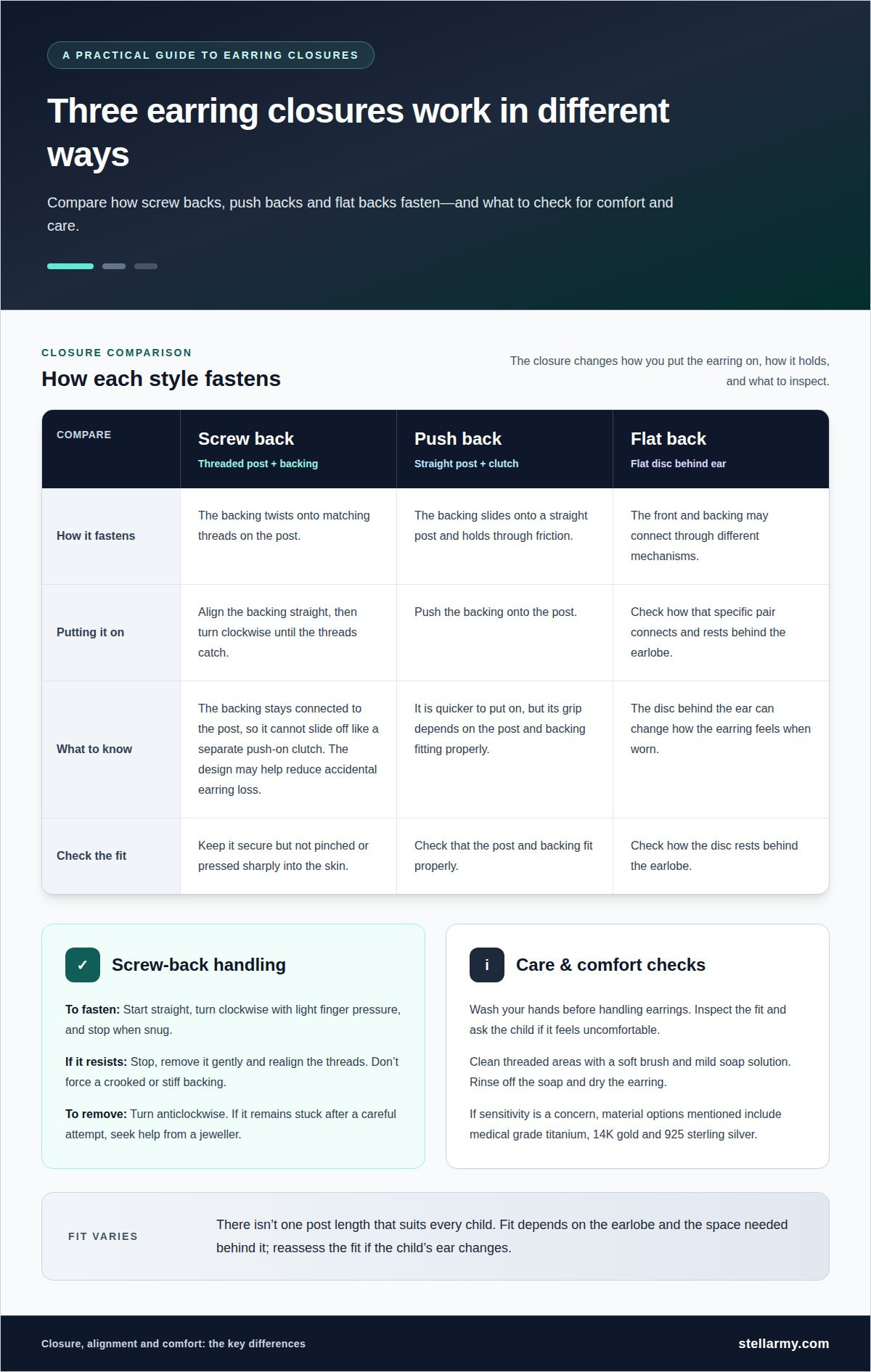
- Screw backs turn onto threaded posts. The backing stays connected to the post, so it cannot slide off like a separate push-on clutch.
- Push backs slide onto a straight post and hold through friction. They are quicker to put on, but their grip depends on the post and backing fitting properly.
- Flat backs have a flat disc behind the ear. Their front and backing may connect through different mechanisms, so check how that specific pair fastens.
For example, when fastening screw backs, a parent needs to align the threads before turning. A push-back pair instead needs its backing pushed onto the post. A flat-back design may have a disc resting behind the earlobe, changing how the earring feels when worn. These differences affect handling as well as appearance. Match the closure to the child’s comfort and the caregiver’s ability to manage it.
How do I clean and care for kids’ screw-back earrings? Use a soft brush and mild soap solution, paying attention to the threaded areas. Rinse off the soap and dry the earrings before storing or wearing them again.
Threaded grooves can collect residue, so include the post and backing in routine cleaning. Handle each piece carefully while cleaning; small backings can be easy to misplace. If the child has sensitive ears, material also matters. Medical grade titanium is one available earring material, while 14K gold and 925 sterling silver are other options.
In Malaysia, consider how the closure works with the child’s ear shape and comfort. A secure fastening still needs to sit correctly. Check the backing’s position after putting the earring on, and notice if the child reports pressure or irritation.
What Should You Do If Screw Backs Get Stuck?
A stuck backing calls for patience, not extra force. First, steady the child’s head and explain each movement. Ask them to stay still while you inspect the backing. If the earring is painful, stop handling it. Pulling or twisting sharply can strain the earlobe and make the situation harder to manage.
Tight-fitting latex or rubber gloves can improve your grip on a small backing. Gently hold the earring front, then try turning the backing anticlockwise. Keep movements slow and controlled. If it doesn’t move, pause instead of gripping harder. A better grip helps you stay in control; it doesn’t make force safe.
- Check the position. Look for a backing sitting straight behind the earlobe.
- Improve your grip. Put on a snug latex or rubber glove.
- Try gentle lubrication. Use a small amount around the stuck threading, keeping it away from the piercing.
- Stop if it remains stuck. Seek help from a jeweller rather than forcing the mechanism.
Use lubrication sparingly to ease movement at the threads, not to coat the ear or earring. Keep the child still, and don’t let lubricant enter the piercing. If the backing remains difficult to remove after gentle lubrication, a jeweller can assess the fastening without repeated pulling at home.
Screw backs have a practical drawback: their threaded mechanism takes more handling than a simple push-on backing. Small parts can be hard to grip, especially on a restless child. The backing may also feel uncomfortable if it presses against the earlobe. A stuck fastening can make routine removal stressful, so stop if the child reports discomfort.
Sensitive ears need extra attention to comfort and material. Notice if the earlobe feels sore or the child reacts when the earring moves. Don’t keep twisting the backing against an already uncomfortable ear. The material may also matter if the child has a known sensitivity. Choose a material the child has tolerated before, and don’t assume every metal feels the same.
For example, if a child says, “It hurts when you turn it,” pause immediately. Don’t respond to a tight backing by applying more pressure. Take a calm break to avoid hurried handling. Resume only if the child is comfortable and the backing turns gently. Otherwise, leave it alone and seek help from a jeweller.
Tight-fitting latex or rubber gloves can improve your grip on small earring backs. Use them only to guide gentle movement. If the backing resists, stop rather than pressing harder.
How screw-back earrings fasten
A screw-back fastening joins two matching parts: a threaded post and a backing. The post passes through the piercing, while the backing’s inner grooves meet the post’s outer grooves. Turning the backing moves it along the post. Each rotation brings it closer to the earlobe, creating a connected fastening rather than a loose push-on fit.
Think of the post as a small screw and the backing as its nut. The grooves must align before they can move together. If the backing starts at an angle, its grooves may not follow the post’s threads. That mismatch explains why a backing can suddenly resist, wobble, or sit unevenly.
Turn clockwise to attach the backing. A smooth turn shows the matching threads are engaging. The backing moves inward until it sits securely behind the ear. Stop when the fit is comfortably snug. Turning further won’t improve the connection once the backing is seated.
The fastening has distinct stages:
- Position: The post enters the piercing, and the backing meets its tip.
- Engagement: The backing begins turning along the post’s threads.
- Seating: The backing reaches its resting position behind the earlobe.
- Release: Turning anticlockwise moves the backing outward for removal.
These stages help explain what you feel through your fingers. When the threads engage, the backing should start moving without force. As it seats, it should stay aligned behind the earlobe. If it tilts or stops, the threads may not be tracking together. Release the pressure and reassess its position before continuing.
Some screw-back designs use rounded backings that cover the end of the post, helping protect the skin behind the ear from being poked. The rounded surface also gives caregivers an easy area to hold while fastening. Check that the backing rests evenly instead of pressing one edge into the child’s skin.
A secure fastening depends on matching threads, not force. A backing that turns smoothly can still feel uncomfortable if tightened hard against the ear. Aim for a secure connection without pinching. For example, if the backing sits flush but the child feels pressure, loosen it slightly and check its position again.
Cleaning helps keep the mechanism working smoothly. Soap residue or debris around the grooves can interfere with turning. Use a soft brush and mild soap solution to clean the threaded areas. Rinse and dry the parts before fastening them again. Check the post and backing for visible residue, then align them carefully.
How to put on and remove screw-back earrings
Prepare before handling a child’s earrings. Wash your hands and choose a well-lit spot. Place a clean cloth beneath the earring to catch the small backing if it slips. Ask the child to sit still and turn their head gently. A steady position makes it easier to guide the post without pulling the earlobe.
If the earlobe feels tight, warmth may make handling more comfortable. Try putting the earring in after a warm shower, or hold a warm, moist cloth against the earlobe. Keep the cloth comfortably warm, not hot. Don’t force an earring through a piercing. If the child feels pain or the post won’t pass easily, stop.
To put the earring on, hold its front securely and guide the post through the piercing without pushing hard. Keep the backing aligned with the post’s tip. Turn it clockwise until the threads catch, then continue gently until it is fully screwed on. The backing should feel secure, not pressed tightly against the ear.
- Prepare: Wash your hands and position the child comfortably.
- Insert: Guide the post through the piercing with gentle pressure.
- Fasten: Turn the backing clockwise, keeping it straight.
- Check: Confirm it sits securely without pinching the earlobe.
To remove the earring, steady its front with one hand and hold the backing with the other. Turn the backing anticlockwise, keeping the post still. Once it moves freely, unscrew it and place it on the cloth. Then gently slide the post out. Don’t tug the front or pull the backing away before its threads release.
If a backing resists, pause rather than applying more force. Reposition your fingers and try another gentle turn. If the child moves, stop and help them settle before continuing. If the backing remains stuck, follow the separate stuck-backing guidance instead of twisting harder. This helps prevent careful removal from becoming a painful struggle.
After removal, keep the backing and earring together in a clean, secure place. Before wearing them again, check that the post and backing look clean and undamaged. A bent post or rough thread can make fastening difficult. If the earlobe feels sore, don’t press the earring back into place.
For practical piercing aftercare guidance, use advice that addresses cleaning and handling around the piercing. A consistent routine helps make each fastening and removal more controlled.
Stellar Malaysia: Ear Piercing
Stellar Malaysia offers ear piercing for adults and children, plus earrings in 14K gold, 925 sterling silver, and medical grade titanium. If you’re choosing earrings for a child or considering a new piercing, an expert consultation can help you discuss suitable options and comfort.
For children with sensitive ears, material is one practical factor to consider. Medical grade titanium, 14K gold, and 925 sterling silver provide distinct choices to discuss alongside the earring’s fit and fastening style. A consultation is also a useful next step when planning a lobe piercing and selecting earrings for it.
Explore ear piercing and earring options with Stellar Malaysia at stellarmy.com.
Make the next choice with confidence
If you’re considering screw-back earrings for kids in Malaysia, choose a routine that suits the child, not just the fastening. Include your child in simple comfort checks, and notice whether they can sit still during handling. A calm, consistent approach makes everyday earring care easier.
Use the same careful attention when planning a new ear piercing or choosing earrings. Stellar Malaysia offers ear piercing, 14K gold earrings, and 925 sterling silver earrings. If you’re ready to discuss your child’s ear-piercing plans, contact Stellar Malaysia. Take the next step at a pace that feels right for your family.
Frequently Asked Questions
What materials are safest for children's screw-back earrings, such as gold, titanium, or surgical steel?
No single material is the right choice for every child; consider known sensitivities and comfort. Stellar Malaysia offers 14K gold, 925 sterling silver, and medical grade titanium earrings. If a child has reacted to particular jewellery before, avoid assuming another metal will suit them. Surgical steel is not interchangeable with these material descriptions, so don’t rely on the name alone to judge suitability.
How do screw-back earrings compare with push-back earrings for kids?
Screw backs twist onto threaded posts, while push backs slide onto posts and rely on friction to stay in place. If a child often catches an earring while dressing, the fastening style can affect how easily it comes loose. Screw backs require more care during removal. Push backs are simpler to remove, but caregivers should still check that each backing is secure before the child wears the earrings.
Are screw-back earrings safe for babies and young children?
A screw-back closure alone doesn’t make earrings suitable for every baby or child. Fit, comfort, and an adult’s ability to manage the small backing all matter. Before booking, check the studio’s current age requirements for ear piercing. For children under 16, piercing requires a parent or guardian present, or written parental consent. Those rules concern piercing, not a blanket guarantee that a particular earring suits every child.
How do I put on and tighten children's screw-back earrings?
Wash your hands and have the child sit still in a well-lit spot. Gently guide the post through the piercing, then hold the front steady as you turn the backing clockwise. Stop when it feels secure and comfortable. If it catches, feels crooked, or causes discomfort, don’t force it. A backing that presses tightly against the ear needs repositioning, not further tightening.
What are the risks of tight screw-back earrings, including irritation or infection?
A backing pressed firmly against the earlobe can cause pinching and discomfort, while friction may irritate the skin. Tightness alone doesn’t mean there is an infection. Handle earrings with clean hands, and avoid repeatedly twisting a sore ear. If you suspect an infection or the child’s symptoms are worsening, seek medical advice rather than trying to fix it by tightening or forcibly removing the backing.
Do Malaysian shops offer children's screw-back earrings in hypoallergenic or nickel-free options?
Stellar Malaysia offers hypoallergenic options for sensitive skin, alongside 14K gold, 925 sterling silver, and medical grade titanium earrings. “Hypoallergenic” and “nickel-free” aren’t identical claims, so don’t assume one automatically means the other. If nickel avoidance matters for your child, choose a product specifically labelled nickel-free. Match the material to the child’s known sensitivities and pay attention to comfort during wear.