

A tiny cartilage piercing can take months to settle. A forward helix piercing in Malaysia sits on the upper outer ear cartilage, above the tragus, and typically takes 6-9 months to heal. The exact fit matters: ear shape affects whether one, two or three piercings can sit comfortably in this area.
If you’re weighing up the look, it’s natural to wonder how much it hurts and which jewellery works while it heals. Pain is commonly rated 5 to 6 out of 10, while suitable starter jewellery and careful placement help account for swelling and your ear’s anatomy. This guide explains the placement, pain expectations, jewellery choices and healing timeline, then shows what to consider before choosing a double or triple forward helix.
Key Takeaways
- A forward helix sits on the upper outer ear cartilage above the tragus, and healing typically takes 6-9 months.
- Plan for tenderness and swelling early on, and avoid pressure or twisting the jewellery while the piercing heals.
- A triple piercing stacks three placements, but the available cartilage and spacing determine whether the arrangement suits your ear.
- Starter jewellery is typically a 16G flat-back labret; material and fit should allow for initial swelling.
- Pain is commonly rated 5 to 6 out of 10, though the sensation varies from person to person.
What is a forward helix piercing?
A forward helix piercing passes through the cartilage at the front of the upper ear, above the tragus, where the ear meets the head. Its position differs from a regular helix piercing along the outer upper rim. Both involve cartilage, but their locations affect how jewellery sits and how easily it catches on hair or clothing, or is pressed during healing.
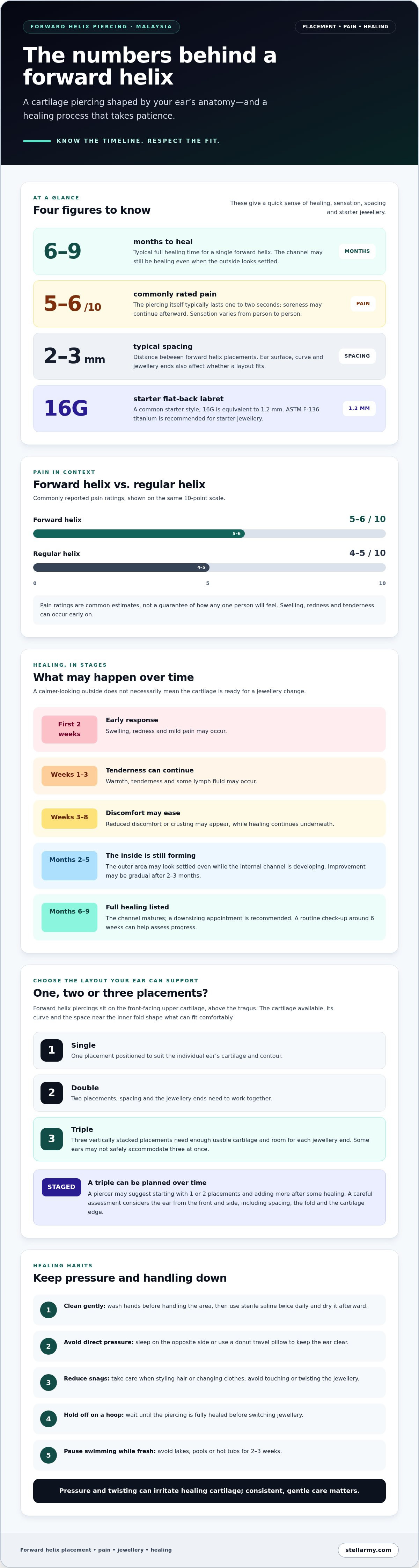
Healing takes time. A single forward helix typically needs 6-9 months to heal, while a standard helix typically takes 6 to 12 months. During the first 2 weeks, swelling, redness and mild pain may occur. Weeks 1-3 can also bring warmth, tenderness and some lymph fluid. Reduced discomfort or crusting may appear during weeks 3-8, but the piercing can still be healing beneath the surface.
At months 2-5, the outer area may look settled while the internal channel is still forming. Full healing is listed at months 6-9, when the channel matures and a downsizing appointment is recommended. Improvement may become gradual after 2-3 months; looking calm outside doesn’t mean the cartilage is ready for jewellery changes. A routine check-up around 6 weeks can help assess progress.
Pressure can irritate a healing piercing and may contribute to jewellery migration. Sleep on the opposite side or use a donut travel pillow to keep the ear free from direct pressure. Take care when styling your hair or changing clothes, as snags can tug on the jewellery. Avoid twisting or touching it, and wait until the piercing is fully healed before switching to a hoop.
For care, wash your hands before handling the area, then gently clean it with sterile saline twice daily. Dry the area afterward, since lingering moisture can encourage bacteria. Avoid swimming in lakes, pools or hot tubs for 2-3 weeks while the piercing is fresh. These steps support a consistent routine; the piercing aftercare guidance covers cleaning and daily care.
Forward helix pain is commonly rated 5 to 6 out of 10, compared with 4 to 5 out of 10 for a regular helix. The piercing itself typically lasts one to two seconds, though soreness can continue afterward. Swelling, redness and tenderness are possible early effects; pressure during sleep can add irritation or contribute to migration.
For a forward helix piercing in Malaysia, age and consent requirements can depend on the circumstances and studio policy. If the person getting pierced is a minor, involve a parent or guardian and establish consent before the appointment.
The human head weighs about 8-10 lbs, and that weight can press against a forward helix piercing during sleep while it is healing. Keeping the ear clear of direct contact is therefore a practical way to limit sleep-related pressure. Sleep on the opposite side of the piercing, or use a donut travel pillow to suspend the ear rather than resting it against a surface. Choose whichever arrangement lets you maintain that separation comfortably; the aim is to avoid putting pressure on the healing cartilage as you rest.
Forward helix placement and piercing variations
A forward helix piercing sits on the front-facing cartilage at the top of the ear, where the outer rim meets the head. Its position differs from a standard helix along the outer edge. The available cartilage, its curve and the space near the ear’s inner fold all affect where jewellery can sit. Placement should follow the ear’s natural contour rather than force a preferred layout onto unsuitable tissue.
For a single piercing, the entry point is selected to suit the cartilage and the intended jewellery. With multiple piercings, spacing becomes part of the design and the healing plan. Forward helix piercings placed together are typically spaced 2-3 mm apart. That measurement describes the distance between placements; the available surface and the jewellery ends also influence whether a pattern looks balanced and has room to settle.
A double forward helix uses two placements along the front cartilage. A triple forward helix stacks three piercings vertically for a more defined line. Three placements need enough usable cartilage and room for each jewellery end. The ear’s curve can make spacing uneven, so a straight-looking stack may not suit every ear. A careful layout accounts for the edge, fold and available surface before piercing.
Wanting three piercings doesn’t mean all three must be placed in one appointment. When a triple is the goal, a piercer may recommend starting with 1 or 2 piercings, then adding more after some healing. This staged approach lets the first placements settle before a new point is added. Some ear anatomies may not safely accommodate three at once or heal well with them placed together, so layout and tissue capacity matter more than the target count.
During a placement assessment, the pattern is considered from the front and side. Jewellery that looks well spaced from one angle may sit close to the ear’s fold from another. The ends should not compress the skin or crowd the cartilage edge. These details matter for a single piercing and become more important with two or three.
- Single: one placement, positioned around the individual ear’s cartilage and contour.
- Double: two placements, with spacing and jewellery ends considered together.
- Triple: three vertically stacked placements, sometimes planned across separate appointments.
After placement, avoid touching or twisting the jewellery. Clean the area gently with sterile saline twice daily during healing. Consistent aftercare helps avoid unnecessary handling and pressure on the planned placements.
Initial jewelry options and materials
A forward helix usually starts with a 16G flat-back labret. The flat back sits behind the ear, while the decorative end shows at the front. This profile suits a compact placement better than jewellery that projects outward. A 16G post is equivalent to 1.2 mm gauge, giving you a useful reference when comparing jewellery specifications for your forward helix piercing malaysia journey.
Material is another part of the initial setup. ASTM F-136 titanium is recommended for starter jewellery, and 14k gold is also recommended as an initial material. Medical grade titanium and gold are familiar choices in piercing jewellery, but the metal alone doesn’t decide fit. The post length, end size and position must also work with the ear’s cartilage and the swelling expected after placement.
Length is fitted to the ear, not chosen by appearance alone. A typical starter bar length is 4-5 mm, while a post is typically fitted at 6 mm during initial swelling. Once swelling has resolved, the post is typically downsized to 4 to 5 mm. These measurements describe different fitting stages, not a universal single size. The right length gives the tissue room without leaving an unnecessarily long post.
For the decorative end, a forward helix top is typically kept to 3 to 4 mm in diameter during healing. Smaller details can also help multiple piercings sit neatly: initial jewellery tops for a triple forward helix are typically 2-3 mm. That compact scale leaves space for neighbouring ends, though the ear’s shape still determines the final arrangement. A large top may crowd the area or catch more easily during hair styling.
Think of initial jewellery as a functional setup, not the final styling choice. A flat-back labret provides the starter format; once the piercing is fully healed, jewellery options can change. In particular, avoid hoops until it’s fully healed, since movement can irritate a fresh piercing. Keep the initial design simple, then plan an ear stack around the available space and each piece’s size.
Before cleaning, wash your hands and handle the jewellery gently. Aftercare should stay consistent while the channel heals; avoid twisting the labret or changing it for appearance alone. Dry the area after cleaning, and take care when dressing or styling hair. The piercing aftercare guidance from Stellar Malaysia explains the routine for caring for a fresh piercing.
When comparing options, focus on four details: the 16G gauge, the post length for the current healing stage, the material, and the decorative end’s diameter. Those specifications make it easier to discuss a comfortable initial fit before considering a more elaborate stack.
Understanding these details makes it much easier to assess whether a piece suits the healing setup. One listed option is the 9k solid yellow gold crystal gem flat back labret stud earring, which has a 2mm gem. A general recommendation is to start with a longer stud to allow room for swelling, then size down once the piercing has healed.
Pain expectations
A forward helix is commonly rated 5 to 6 out of 10 for pain. The piercing itself typically lasts one to two seconds, but tenderness can continue afterward. That brief moment and the longer healing period are different experiences, so plan for both rather than judging the whole process by the initial sensation.
For comparison, a standard helix is typically rated 4 to 5 out of 10. The difference is modest, and neither rating predicts exactly how your ear will feel. The cartilage’s shape, the precise placement, your sensitivity and whether the area is already irritated can all influence the experience. One person’s rating is a guide, not a personal forecast.
During the appointment, steady breathing can help you stay relaxed while the technician positions the jewellery. Let them know if you need a pause before the piercing begins. The procedure is brief, though pressure or tenderness may remain afterwards. Avoid touching or twisting the jewellery, as extra handling can irritate the area during healing.
The sensation can also change over time. Mild pain, redness and swelling may occur during the first 2 weeks. Those early signs don’t mean the cartilage has fully healed once they settle. A forward helix typically takes 6-9 months to heal, so the tissue needs continued care after the initial tenderness fades.
Jewellery selection and placement can affect comfort after the appointment. A flat-back labret sits close to the ear, while a hoop moves more freely. Wait until the piercing is fully healed before switching to a hoop. With stacked placements, each piercing is a separate healing site that needs protection from pressure and snags.
Sleep is a practical source of pressure on a healing forward helix piercing, even if it felt manageable at first. Sleep on the opposite side or use a donut travel pillow to keep pressure off the ear. Take care when styling your hair or changing clothes, since a snag can pull the jewellery and make the area sore.
Keep expectations realistic for a stacked design. Up to three forward helix piercings may be performed in one session when anatomy supports it, but four or more are uncommon. More placements mean additional sites to care for, not simply a stronger visual effect. The right pace depends on how the ear accommodates each piercing and how well it settles.
To judge progress, focus on changes over time rather than one moment of discomfort. Increasing pain or persistent irritation deserves attention, while some tenderness can occur during healing. Follow the aftercare routine, avoid unnecessary pressure and leave the jewellery in place as the cartilage heals.
Anatomy suitability for triple forward helix piercings
A triple forward helix needs more than three visible points. The front of the ear must have enough cartilage and surface area for three jewellery ends, with space between placements. A technician assesses the ear’s curve, thickness and fold before planning the pattern. These features help determine whether a single, double or triple arrangement can sit without crowding.
For a double forward helix, the accessible cartilage typically needs to measure at least 10 to 14 millimeters. Each piercing in a double or triple arrangement needs approximately 5 to 7 millimeters of clearance from its neighbour. The front of the ear must also accommodate at least 3 ends for a triple. These measurements guide assessment, but the actual contour and usable area shape the final layout.
A single piercing uses one suitable point. A double adds a second placement, so both jewellery ends must fit without pressing against the ear’s fold. A triple stacks three placements vertically and requires more space. An ear may have room for a double but not enough accessible cartilage for a third. Placement should follow the natural anatomy rather than force a symmetrical design.
Up to three forward helix piercings may be performed in one session when the anatomy supports it. However, some ears may not safely accommodate three at once or heal well with them placed together. If a triple is the goal, starting with 1 or 2 piercings and adding more after some healing can make the plan more manageable. Each new placement adds another healing site and another jewellery end to protect from pressure.
Before choosing a triple, consider how the placements look from the front and side. A jewellery end that appears clear from the front may sit too close to the ear’s fold when viewed at an angle. Spacing must account for the size of the jewellery ends, not just the piercing points. Smaller ends may suit a tighter arrangement, while larger ones can crowd the available surface.
Ask for the proposed pattern to be assessed against your ear’s actual cartilage and the planned jewellery. A sterile hollow needle, rather than a piercing gun, is recommended for helix piercings. If the anatomy supports only one or two placements, that smaller arrangement is the practical choice. A triple should not come at the expense of safe spacing or a workable healing plan.
For an anatomy-based assessment and forward helix piercing, book a piercing appointment.
Stellar Malaysia: Ear Piercing
Stellar Malaysia offers forward helix piercing and consultations to help you consider placement and suitable jewellery. If you’re deciding between a single piercing and a stacked look, a consultation can help clarify how your ear’s anatomy affects the plan.
Jewellery options include 14K gold earrings, 925 sterling silver earrings and medical grade titanium earrings. These choices let you discuss material alongside placement, comfort and the needs of a healing piercing. A clear plan connects the piercing decision with the jewellery you’ll wear.
For a forward helix piercing or guidance on jewellery options, contact Stellar Malaysia or visit stellarmy.com.
Make Your Next Piercing Choice With Confidence
Your next step is to turn the look you want into a practical plan. Decide whether you prefer a single, double or triple arrangement, then consider how it fits your ear and everyday routine. A clear preference helps guide a focused conversation about placement and jewellery, without committing to a layout that doesn’t suit your anatomy.
If you’re considering a forward helix piercing in Malaysia, Stellar Malaysia offers Ear Piercing alongside 14K Gold Earrings and 925 Sterling Silver Earrings. You can discuss how your preferred look and jewellery choices work together before moving forward. The right decision is the one that makes sense for your ear, your style and the care you’re ready to maintain.
Take the next step at your own pace. Contact Stellar Malaysia about your piercing to explore your options and move towards a choice that feels right for you.
Frequently Asked Questions
What should I check when choosing a piercing studio in Malaysia?
Choose a studio that can explain its hygiene process, equipment and consent requirements before the procedure. At Stellar Malaysia, certified technicians complete an intensive training course; stations and tools undergo daily sterilisation, and each piercing uses a disposable, vacuum-packed earring cartridge. The procedure uses an advanced hand-pressure instrument, not a spring-loaded gun. For customers under 16, a parent or guardian must accompany them or provide written consent.
What jewelry is suitable for a forward helix piercing?
An initial forward helix typically uses a 16G flat-back labret; ASTM F-136 titanium or 14k gold are recommended materials. Match the post’s fit to the ear and healing stage, rather than choosing by decorative end alone. Medical grade titanium, 14K gold and 925 sterling silver earrings are available. Not every style suits a fresh cartilage piercing, so prioritize the initial fit and material choice over appearance.
How can I tell whether my ear anatomy is suitable for a forward helix piercing?
Check whether the front-facing cartilage above the tragus has enough usable surface for your preferred placement. A double typically needs at least 10 to 14 millimeters of accessible cartilage, with 5 to 7 millimeters of clearance between placements. A triple also needs room for three jewellery ends. Ear folds and curvature can reduce usable space, so have the planned layout assessed against your ear before settling on the number of piercings.
What are the risks and complications of a forward helix piercing?
Possible effects include swelling, redness, tenderness and mild pain during early healing. Pressure from sleeping on the piercing can cause irritation or migration, while snags and lingering moisture can also cause problems.